Patients from Elbistan and the Region
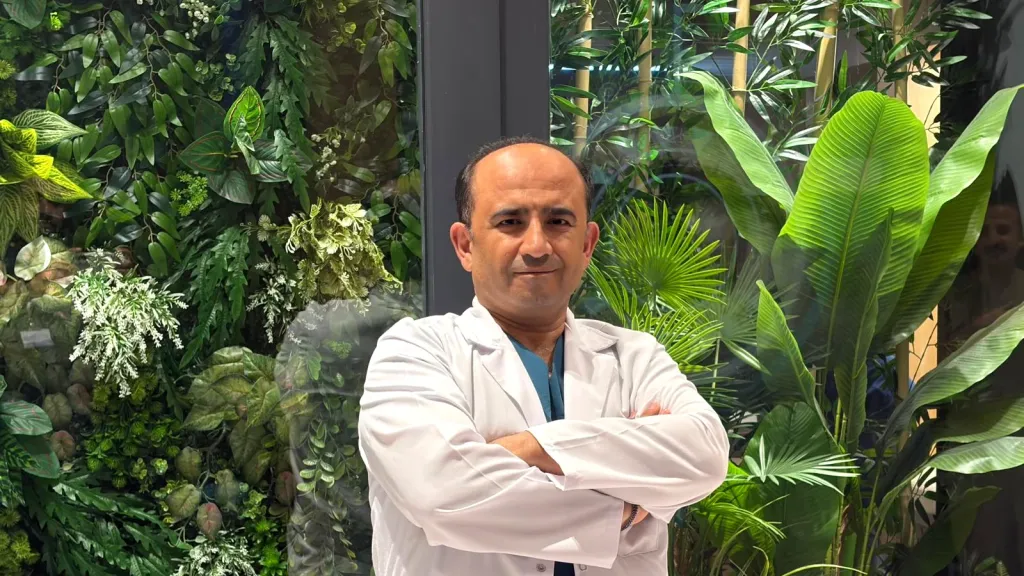
Dr. Nejmi Öztürk, ophthalmologist and eye surgeon from Elbistan — examinations and operations only at HG Hospital in Kahramanmaraş, Türkiye; travel and planning information for people coming from Elbistan, Afşin, Göksun, Ekinözü and Nurhak
- Dr. Nejmi Öztürk does not see patients in Elbistan; all examinations, tests and operations take place at HG Hospital in Onikişubat, Kahramanmaraş.
- The Elbistan–Kahramanmaraş road is about 148 km and takes about 2 hours (via Göksun); Afşin is about 123 km and Göksun about 78 km away.
- Say that you are travelling from afar when you book; the examination and tests are grouped into the same day, and surgery is planned for a separate day.
- In the case of sudden loss of vision, severe pain, a chemical in the eye or an injury, go first to the emergency department nearest to where you are.
Does Dr. Nejmi Öztürk see patients in Elbistan?
No. Dr. Nejmi Öztürk, ophthalmologist and eye surgeon, is originally from Elbistan and a graduate of Elbistan Anadolu Lisesi (high school); however, he has no practice in Elbistan and no institution there where he sees patients. All examinations, tests and operations take place in the Ophthalmology department of HG Hospital in the Onikişubat district of Kahramanmaraş (Üngüt Mevkii, Prof. Dr. Necmettin Erbakan Bulvarı No:209).
If you are searching for an “Elbistan eye doctor”, this is what you need to know: to be examined by Dr. Öztürk you need to come to Kahramanmaraş. This page was prepared so that patients from Elbistan, Afşin, Göksun, Ekinözü and Nurhak can plan their journey and treatment with as few round trips as possible. Many families with roots in Elbistan live abroad and visit Türkiye in the summer; if this applies to you, mention the length of your stay when booking, so that the examination, any treatment and the follow-up visits can be planned within your stay.
Travelling to Kahramanmaraş from Elbistan, Afşin, Göksun, Ekinözü and Nurhak
The road from Elbistan to Kahramanmaraş via Göksun is about 148 km and takes about 2 hours by car. Setting off early in the morning gives you time to finish the examination and tests within the same day.
| District | Distance to Kahramanmaraş (approx.) | Note |
|---|---|---|
| Elbistan | 148 km, about 2 hours | Via Göksun |
| Afşin | 123 km | Via Göksun |
| Göksun | 78 km | On the Elbistan route |
| Ekinözü | Close to Elbistan | Work out the time according to your own route |
| Nurhak | Close to Elbistan | Work out the time according to your own route |
- Book a morning appointment: A dilated examination and tests such as OCT and a visual field test take time; a patient who arrives in the morning can have everything completed the same day.
- Check the road in winter: The Göksun route can be affected by snow and ice in the winter months. Check the road and weather conditions before setting off; in bad conditions, call the hospital to postpone your appointment.
- Do not drive yourself on the day of the examination: The drops that widen the pupil blur near vision for 4–6 hours and cause sensitivity to light. Bring someone who can drive, or use public transport; sunglasses reduce light sensitivity on the way back.
- Confirm timetables yourself: Bus and minibus times are not given on this page; find them out before you set off and allow plenty of time for your return.
- Arrange a companion for elderly patients and children: The journey and the examination day can be tiring.
How are the examination, tests and planning done on the same day?
For patients travelling from afar, the examination and the necessary tests are grouped into the same day; if surgery is needed, it is planned for a separate day. To make this possible, say which district you are coming from and what your complaint is when you book; the time needed for tests such as OCT, corneal topography, a visual field test or biometry (lens measurement) is then set aside on the same day.
- Appointment: Say that you are coming from afar, describe your complaint and mention the reports you have; ask for a morning slot.
- Preparation: Bring your ID, glasses, list of medicines and old reports (OCT, topography and visual field printouts). For a laser assessment, stop wearing soft contact lenses 1 week and rigid lenses 2–3 weeks beforehand.
- Examination and tests: The examination takes 30–60 minutes; a 20–30 minute wait is added for a dilated examination. The tests are completed the same day and the results are explained the same day.
- Plan: If surgery is needed, the date, the pre-operative preparation (adjusting blood thinners, anesthesia assessment, insurance paperwork) and the follow-up schedule are set out in writing at this consultation.
- Surgery day and the day 1 check-up: The day of surgery and the check-up the next day are planned together. Spending the night after surgery in or near Kahramanmaraş and returning to your district after the morning check-up reduces the travel burden; the choice of accommodation is yours.
For procedures such as cataract surgery, laser eye surgery and eyelid surgery, the examination and the operation are not done on the same day, because assessing the measurements, adjusting blood thinners and the paperwork take time. You should therefore plan at least two journeys (the examination day and the surgery day).
How are post-operative check-ups planned for patients travelling from afar?
The follow-up schedule depends on the treatment; for patients travelling from afar, check-ups are combined wherever possible and planned with the travel time in mind. The table below is a general framework; your personal schedule is given to you in writing at the examination.
| Treatment | Typical follow-up schedule | Planning for patients travelling from afar |
|---|---|---|
| Cataract surgery | Day 1, week 1, month 1 | Surgery and the day 1 check-up together; later check-ups spaced out; the two eyes on separate days |
| Laser eye surgery (SMILE, LASIK, No-Touch, PRK) | Day 1, week 1, month 1, month 3; for surface methods, a bandage lens check on day 3–5 | Assessment and measurements on the same day; the procedure on a separate day; check-ups combined according to the travel time |
| Glaucoma follow-up | Pressure check 4–6 weeks after starting drops; every 3–6 months once stable | Pressure measurement, OCT and visual field test grouped into the same day |
| Intravitreal injection (macular degeneration, diabetes) | Monthly during the loading phase; then the interval is extended according to the OCT result | OCT and injection on the same day; as the intervals get longer, the number of journeys falls |
| Strabismus surgery | Day 1, week 1, month 1, month 2–3 | Check-up days spaced out; lazy eye follow-up continues |
| Eyelid surgery (ptosis, blepharoplasty) | Stitch removal on day 5–7; month 1, month 3 | Stitch removal and check-up grouped into the same day |
Between check-ups, instructions on using the drops, protecting the eye and restrictions (no heavy lifting, swimming pools or dusty environments) are given in writing. After a vitrectomy in which gas is placed inside the eye, a change in altitude can raise the pressure inside the eye, so the timing of your return over the mountain road is decided together with your doctor; details are on the vitrectomy page. If an unexpected symptom occurs, do not wait for the check-up day; see the emergency section below.
What should you do in an emergency?
In the case of sudden loss of vision, severe eye pain, a chemical splashing into the eye or an eye injury, go to the emergency department nearest to where you are; do not wait out the 2-hour journey to Kahramanmaraş. The emergency department of the hospital in your district provides the necessary care and arranges a referral if needed. The following symptoms are emergencies:
- Sudden loss of vision or vision closing off like a curtain (retinal detachment, blocked blood vessel)
- Severe painful redness; if headache and nausea accompany it, it may be an acute glaucoma attack
- Sudden flashes of light and a sudden increase in floaters (retinal tear)
- A chemical in the eye: first rinse with plenty of water for 15–20 minutes, then go to the emergency department
- A blow to the eye, a cut, a metal fragment in the eye
- After surgery, increasing pain, increasing redness, yellow discharge, a sudden drop in vision (these may be signs of an infection inside the eye)
After emergency care, inform Dr. Öztürk of your situation; the further treatment and check-ups are replanned. Patients who have had surgery are given written instructions on what to do in an emergency when they are discharged.
Which treatments can you come for?
Dr. Öztürk examines and treats a wide range of eye diseases. The main topics and information pages:
- Cataract and lens surgery: monofocal, toric and trifocal lens options; cataract surgery is performed by Dr. Öztürk at HG Hospital.
- Laser eye surgery (laser vision correction): suitability for SMILE, LASIK, No-Touch and PRK is assessed with the examination and measurements at HG Hospital; the method that suits you is planned together.
- Keratoconus treatment: follow-up with topography, assessment of suitability for cross-linking.
- Retinal diseases: diabetic retinopathy, macular degeneration, intravitreal injections, laser and vitrectomy.
- Eye diseases and treatments: glaucoma, strabismus and children’s eye examinations, eyelids, dry eye, tear ducts, pterygium, blepharitis and uveitis.
HG Hospital is a private hospital contracted with the Turkish social security institution (SGK); patients with valid SGK coverage may use it, although a private-hospital co-payment may apply, and private health insurance policies are accepted. Patients without SGK coverage, such as visitors from abroad, pay privately or through their private or travel health insurance; the hospital checks coverage before treatment. Coverage conditions do not depend on which district or country you come from and are clarified at the consultation.
Dr. Nejmi Öztürk sees patients at HG Hospital in Kahramanmaraş, Türkiye. For patients travelling from other districts or from abroad, examination, tests and treatment planning can be arranged for the same day.
Hospital switchboard (within Türkiye): 444 46 46 · E-mail: info@nejmiozturk.com · HG Hospital, Üngüt Mevkii, Prof. Dr. Necmettin Erbakan Blv. No:209, Onikişubat / Kahramanmaraş, Türkiye
Frequently asked questions
Can I be examined by Dr. Nejmi Öztürk in Elbistan?
No. Although Dr. Öztürk is from Elbistan, he does not see patients there; examinations and operations take place only at HG Hospital in Kahramanmaraş. For patients coming from Elbistan, the examination and tests are grouped into the same day.
How long does it take to get from Elbistan to Kahramanmaraş?
By car via Göksun it is about 148 km and takes about 2 hours. Snow and ice can lengthen the journey in the winter months; check the road conditions before setting off.
I am coming from Afşin or Göksun; can I go back the same day as the examination?
On the examination day, usually yes; the examination and tests are finished the same day. Because you will not be able to drive for 4–6 hours after a dilated examination, someone else needs to drive on the way back. On the day of surgery, however, you are advised to stay in Kahramanmaraş for the check-up the next morning.
How many times do I need to come to Kahramanmaraş for surgery?
At least twice: the examination and test day, and the surgery day. The check-up on the day after surgery is completed by staying in Kahramanmaraş on the night of the operation. Later check-ups are combined according to the treatment; the table above shows the general schedule.
Does a 2-hour car journey after surgery harm the eye?
After cataract, laser and eyelid surgery, travelling by car as a passenger is generally not a problem; do not drive yourself, wear sunglasses and do not rub your eye. After a vitrectomy in which gas is placed in the eye, a change in altitude can affect the pressure, so the timing of your return is planned with your doctor.
Do I need to bring my old reports and test printouts?
Yes. Previous examination reports and OCT, corneal topography and visual field printouts are valuable because they show how the condition has developed, and they may save you from repeating some tests. Also bring a list of the drops and medicines you use.
If a sudden eye problem occurs while I am in Elbistan, what should I do first?
In the case of sudden loss of vision, severe pain, a chemical in the eye or an injury, first go to the nearest emergency department in your district; waiting out the journey can harm the eye. After emergency care, inform Dr. Öztürk of the situation. For patients who have had surgery, the emergency instructions given at discharge apply.
I am bringing my child from Elbistan for an examination; what should I keep in mind?
Book a morning appointment; in children the glasses prescription is measured with drops that relax the focusing muscle, and the effect of the drops can last 1–3 days. So plan for a day off school and bring previous eye reports. Information on children’s examinations is on the strabismus and lazy eye page.
Are the fees different for patients travelling from afar?
No; fees do not depend on the district or country you live in. Fee information is given by the hospital after the examination; SGK and private insurance coverage is clarified at the consultation.
I am coming from Göksun; can I have my post-operative check-ups in my own district?
It is recommended that the early post-operative check-ups are carried out by the surgeon who performed the operation, so the day 1 check-up is planned in Kahramanmaraş. In an emergency, you should go to the nearest eye doctor or emergency department. In long-term follow-up, the intervals between check-ups are spaced out according to the travel time.
Sources
- Turkish Ophthalmological Society — todnet.org
- American Academy of Ophthalmology (AAO) — aao.org
- National Eye Institute (NEI) — nei.nih.gov
Related pages
- Eye doctor in Kahramanmaraş: HG Hospital, directions and appointments
- Dr. Nejmi Öztürk: training and areas of specialization
- Eye diseases and treatments
- Frequently asked questions
This page is for information only; diagnosis and treatment decisions are made after an examination. The results of any surgical or interventional procedure may vary from person to person. You are advised to obtain detailed advice from your physician before any procedure.
Ophthalmologist and eye surgeon. Graduate of Erciyes University Faculty of Medicine; completed his residency at Ankara Atatürk Training and Research Hospital. With 21 years of experience in cataract and refractive surgery, strabismus, glaucoma, retina and oculoplastic surgery, he sees patients at HG Hospital in Kahramanmaraş, Türkiye. Biography and training
Dr. Nejmi Öztürk
Ophthalmologist and eye surgeon
HG Hospital, Üngüt Mevkii, Prof. Dr. Necmettin Erbakan Blv. No:209, Onikişubat / Kahramanmaraş
+90 506 377 47 68WhatsAppAppointment formHospital switchboard (within Türkiye): 444 46 46 · info@nejmiozturk.com
- Private patients and private health insurance are welcome; patients with SGK coverage may use it (conditions are confirmed by the hospital)
- Same-day examination and test planning for patients travelling from other districts or from abroad
- Getting here and patient information
- Patients from Elbistan and the region