
Frequently Asked Questions
Short answers to the questions most often asked by patients who see Dr. Nejmi Öztürk, ophthalmologist and eye surgeon, at HG Hospital in Kahramanmaraş, Türkiye — grouped by topic
- Questions about appointments, how long the examination takes, dilating drops and preparing for the examination
- Questions about laser eye surgery (laser vision correction), cataract and trifocal lenses, keratoconus, retina, glaucoma, strabismus and eyelids
- Answers on SGK (Turkish social security), private and travel insurance, paying privately and fees, in line with the regulations and without figures
- Travel and planning questions for patients coming from Elbistan, Afşin, Göksun, Ekinözü and Nurhak
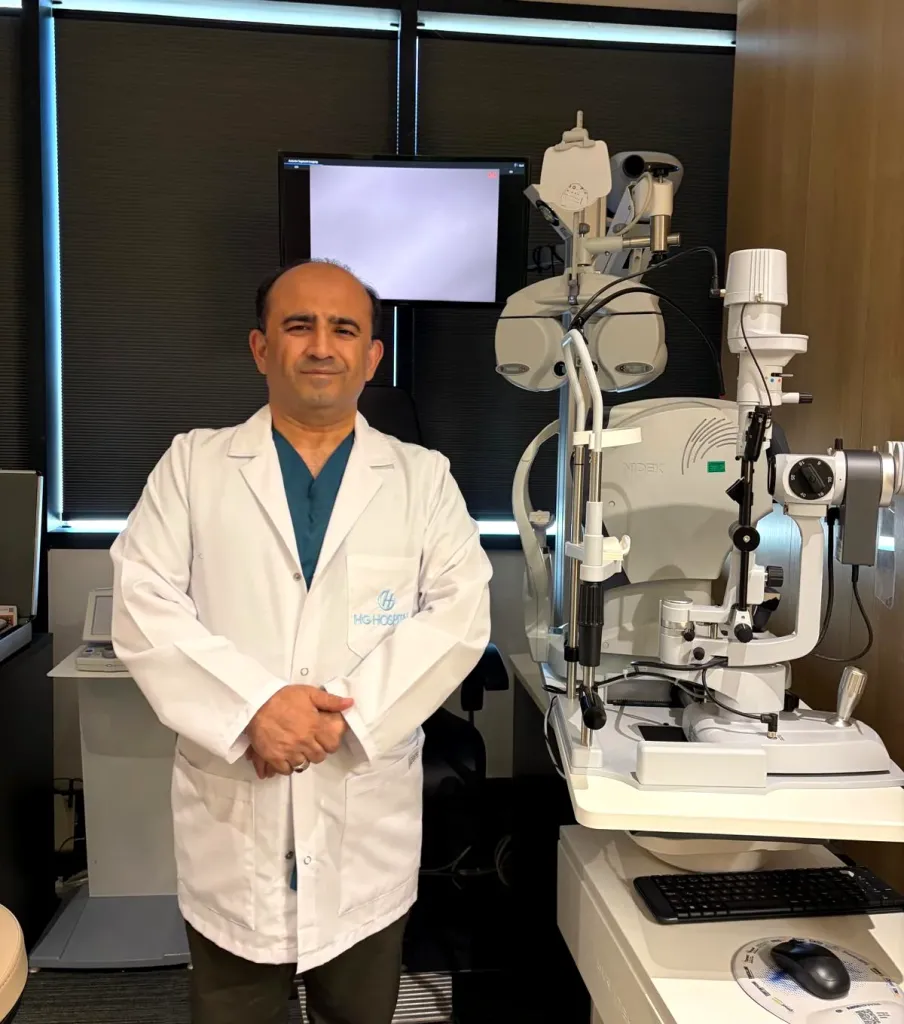
The answers on this page are for general information; your personal situation is assessed at the examination. A detailed explanation of each topic, and the questions specific to that page, can be found through the links at the end of the answers.
Appointments and examinations
How do I make an appointment with Dr. Nejmi Öztürk?
Appointments are made by telephone, WhatsApp or the form in the contact block at the bottom of this page. When booking, mentioning your complaint, which district or country you will be coming from, and whether you have SGK, private or travel insurance makes planning easier. Directions and details of the examination day are on the eye doctor in Kahramanmaraş page.
Which hospital are the examinations held at; is there another branch?
All examinations and operations take place in the Ophthalmology department of HG Hospital in Onikişubat, Kahramanmaraş, Türkiye (Üngüt Mevkii, Prof. Dr. Necmettin Erbakan Bulvarı No:209). Dr. Öztürk has no other practice or branch. For his training and areas of work, see the Dr. Nejmi Öztürk page.
Are drops used at every eye examination?
No; drops that widen the pupil are used when the retina and the optic nerve need to be examined in detail. Their effect lasts 4–6 hours; during this time near vision is blurred and light is uncomfortable. Because dilating drops may be needed, you are advised not to drive on the day of the examination; what a general examination covers is explained on the eye diseases and treatments page.
How long before the examination should I take out my contact lenses?
For a general examination it is enough to come without your lenses on the day. For a laser eye surgery or keratoconus assessment, however, soft lenses are left out for 1 week and rigid (gas-permeable) lenses for 2–3 weeks beforehand so that the corneal measurements are accurate. Take this period into account when choosing your appointment date; details are on the laser eye surgery page.
How long will I be at the hospital for the examination and tests?
The examination takes 30–60 minutes; a 20–30 minute wait is needed for a dilated retinal examination, and extra time for tests such as OCT, corneal topography or a visual field test. Because the tests are done on the same day whenever possible, plan on possibly spending half a day at the hospital. If you are coming from a distant district, ask for a morning appointment.
I have diabetes or high blood pressure; what information should I bring to the examination?
Bring a list of all the medicines you take (including blood thinners), your latest HbA1c and blood sugar values and your previous eye reports. Because diabetes can affect the retinal blood vessels without causing symptoms, a dilated retinal examination is done even if your vision is good. Details are on the diabetic retinopathy page.
Laser eye surgery (laser vision correction)
How do I find out whether I am suitable for laser eye surgery?
Suitability is determined by the examination and measurements: corneal topography (a map of the cornea), corneal thickness, pupil diameter, tear tests and a prescription measurement with drops. The general conditions are being at least 18 years old, a prescription that has been stable for at least 1 year and no corneal disease such as keratoconus. Your suitability is assessed with the examination and measurements at HG Hospital in Kahramanmaraş; the method that suits you is planned together. Information: laser eye surgery.
What is the difference between SMILE, LASIK, No-Touch and PRK?
All of them reshape the cornea with a laser; the difference is in how the cornea is reached. In LASIK a thin flap is lifted, in SMILE a lens-shaped piece of tissue is removed through a small incision, and in No-Touch and PRK the surface layer is removed and the laser is applied directly to the surface. Recovery is slower with the surface methods, but they can be applied to a wider range of thin corneas; the choice is made according to the measurements.
Will I need glasses again years after laser eye surgery?
The laser corrects the prescription you have at the time of surgery and its effect is lasting; however, the eye continues to age. The difficulty with near vision that begins in everyone at around the age of 40 (presbyopia) is not prevented by laser, and reading glasses may be needed. In a small number of patients part of the prescription can return; this possibility is explained at the examination based on your own measurements. Information: laser eye surgery.
When can I return to work and screens after laser eye surgery?
After LASIK and SMILE, return to desk work is usually within 1–3 days; with No-Touch and PRK this takes 1–2 weeks because the surface has to heal. Taking frequent breaks from screens and using artificial tears reduces dryness symptoms. Protective glasses are recommended for dusty and heavy work; the timeline for each method is on the SMILE and PRK pages.
What does the laser feel like?
The procedure is done with numbing drops; no injection or general anesthesia is used. During the laser you are asked to look at a light; there may be a feeling of pressure and a few seconds of darkening. The perception of pain varies from person to person; with the surface methods, stinging and burning are more noticeable for a few days after the procedure. Information: No-Touch laser.
If I am not found suitable for laser, is there another option?
Yes. For a thin cornea or a high prescription, an ICL lens placed inside the eye can be considered, and over the age of 45 or at the onset of cataract, lens exchange with a trifocal lens. If keratoconus is found, the priority is to halt its progression; in that case keratoconus treatment is planned. The suitability of each option is determined by separate measurements.
Cataract and trifocal lenses
Does a cataract need to “ripen” before surgery?
No; today a cataract (clouding of the lens of the eye) is operated on when vision starts to affect daily life. In a very advanced cataract the lens hardens, surgery becomes more difficult and additional problems such as high eye pressure can develop. The timing is decided together at the examination according to your level of vision and your needs. Information: cataract surgery.
Which types of lens are used in cataract surgery?
There are four main groups: monofocal, which sharpens distance vision; toric, which also corrects astigmatism; EDOF, which gives continuous distance and intermediate vision; and trifocal (multifocal), which targets distance, intermediate and near together. The choice depends on the structure of your eye, your occupation and how independent of glasses you expect to be. A comparison is on the lens surgery page.
Will I never need glasses once I have a trifocal lens?
The expectation is that dependence on glasses is greatly reduced; vision without glasses at every distance and in every light cannot be promised. Glasses may occasionally be needed to read very small print in dim light or for long periods of fine work; halos around lights at night may be seen at first and usually lessen. For people who drive at night, an EDOF lens is considered separately. Information: trifocal lens and EDOF lens.
When do I return to daily life after cataract surgery?
You go home the same day; at the check-up the next day the protective shield is removed and the drops are started. Reading, television and light walks are allowed; rubbing the eye, heavy lifting and getting water in the eye are restricted for a week, and swimming pools and Turkish baths for about a month. The glasses prescription is measured once vision has settled, usually after 3–4 weeks. Information: cataract surgery.
I have cataracts in both eyes; how long is there between the operations?
The eyes are usually operated on on separate days; the gap is between a few days and a few weeks and depends on the healing of the eye operated on first. When a trifocal lens is chosen, doing the two eyes close together makes it easier for the brain to adapt to the new way of seeing. For patients travelling from afar, the two operations and the check-ups are planned together. Information: lens surgery.
What happens if vision becomes blurred again years after cataract surgery?
The most common cause is clouding of the back capsule that holds the artificial lens (secondary cataract); the artificial lens itself does not deteriorate and the cataract does not come back. This clouding is cleared with a YAG laser procedure that takes a few minutes as an outpatient and is usually needed only once. Whether the blurring has another cause, such as macular degeneration or glaucoma, is investigated at the examination. Information: cataract surgery.
Keratoconus
How do I know whether I have keratoconus?
Frequent and rapid increases in your glasses prescription, especially the astigmatism, not seeing clearly even with glasses, lights appearing scattered and ghosted vision suggest keratoconus (a cornea that bulges into a cone shape). The diagnosis is made with corneal topography and a thickness map; frequent eye rubbing and allergies increase the risk. Topography is recommended for any young person whose prescription keeps changing. Information: keratoconus treatment.
Does cross-linking make keratoconus go away?
No; cross-linking aims to halt the progression of the disease by stiffening the cornea, and it does not return a cone-shaped cornea to its former shape. After the procedure, the need for glasses or special contact lenses usually continues. It is applied in patients whose disease is progressing and whose cornea is thick enough; your suitability is assessed with the examination and measurements at HG Hospital in Kahramanmaraş. Information: cross-linking.
When is a corneal transplant needed in keratoconus?
A transplant comes into consideration when adequate vision cannot be achieved with glasses and special lenses, when permanent clouding (scarring) develops in the cornea, or when the cornea becomes very thin; this is a small proportion of patients. With early diagnosis and timely cross-linking the need for a transplant can be reduced. Transplants are performed at centers with a cornea bank; for assessment and referral, see the corneal diseases page.
Retinal diseases
I have diabetes and my vision is fine; is a retinal examination still necessary?
Yes. Diabetic retinopathy (retinal damage caused by diabetes) produces no symptoms for a long time; by the time vision deteriorates, the damage may already be advanced. If there is no retinopathy, a dilated retinal examination is done once a year; if there is, every 3–6 months depending on the stage, with OCT when needed. Keeping blood sugar and blood pressure under control is part of the treatment; information: diabetic retinopathy.
Why are the macular degeneration injections repeated?
The anti-VEGF medicine injected into the eye temporarily suppresses the leaking blood vessels; because its effect wears off within weeks, the treatment is repeated at intervals. Usually three monthly injections are given at the start, and the interval is then extended according to the OCT result. The treatment does not eliminate the disease; it aims to preserve vision. Information: macular degeneration.
How quickly should I seek help for sudden flashes of light and floating spots?
The same day. New flashes of light and a sudden increase in floaters can be the sign of a retinal tear; a tear can be sealed with laser as an outpatient in the early period, but if it is left it develops into a retinal detachment (separation of the retina) and requires surgery. If you notice a curtain or shadow in your field of vision, go to the nearest emergency department. Information: retinal diseases.
Does vision fully return after retinal detachment surgery?
The outcome depends on whether the center of vision (the macula) was detached and on how much time passed before surgery. In operations done before the macula is affected, vision is largely preserved; if the macula was detached, vision improves only partly even when the retina is reattached. If gas was placed in the eye, a face-down position is required for a while and you should not go to high altitudes. Information: vitrectomy.
Glaucoma, strabismus, eyelids and other topics
Are eye pressure and blood pressure the same thing?
No. Glaucoma (high eye pressure) is damage to the optic nerve caused by the pressure of the fluid inside the eye, and it is measured independently of blood pressure; a person with normal blood pressure can have high eye pressure. Because glaucoma progresses without symptoms, regular measurement is recommended after the age of 40. Information: glaucoma.
What happens if I forget my glaucoma drops for a day?
Missing one dose does not harm the nerve immediately; use the drops when you remember and return to your routine the next day. Frequently missed doses, however, raise the pressure and allow unnoticed loss of visual field to continue; vision lost to glaucoma does not come back. Using the drops at the same time each day and setting a phone alarm help you keep to the routine. Information: glaucoma.
How do I know whether my child has a lazy eye?
Most of the time you cannot tell; the child does not complain because they see well with one eye. An eye turn, fussing when one eye is covered, squinting and tilting the head to one side to look can be clues; the definite diagnosis is made with a dilated examination. This is why an examination should be done at 6–12 months, at 3–4 years and before school, even without symptoms. Information: strabismus and lazy eye.
Is droopy eyelid surgery cosmetic or medical?
It can be either. If the eyelid covers the pupil and narrows the field of vision, the operation is functional and is documented with a visual field test; blepharoplasty done for appearance alone is cosmetic. This distinction also determines SGK coverage; details are on the blepharoplasty and ptosis page.
Are the drops I buy at the pharmacy enough for dry eye?
For mild dryness, artificial tears bring relief; but if you use them more than four times a day, preservative-free products should be chosen and the cause of the dryness should be investigated. Blepharitis (inflammation of the eyelid margins), blocked eyelid glands or a rheumatic disease may lie behind the dryness; treatment depends on the cause. Drops that whiten the eye (redness relievers) can make dry eye worse. Information: dry eye and blepharitis.
When should a pterygium (surfer’s eye) be operated on?
Surgery is recommended if the pterygium is approaching the visual axis, is impairing vision by causing astigmatism, or is causing constant redness and irritation. A small pterygium without symptoms is monitored with sunglasses and artificial tears. During surgery, a graft taken from the patient’s own conjunctiva is placed to reduce the chance of recurrence. Information: pterygium.
SGK, private insurance and fees
Can I have my examination and surgery at HG Hospital with SGK (Turkish social security)?
Yes. HG Hospital is a private hospital contracted with the Turkish social security institution (SGK); patients with valid SGK coverage may use it for examinations and treatment, although a private-hospital co-payment may apply. The coverage conditions and any co-payment are explained by the hospital before the examination.
Which eye treatments are usually not covered by SGK?
Laser eye surgery (laser vision correction), ICL, lens exchange for the purpose of a trifocal lens and cosmetic blepharoplasty are generally not covered by SGK, and most private health insurance policies also exclude them. In cataract surgery the standard lens is covered; if a trifocal or EDOF lens is chosen, the lens surcharge is paid by the patient. Ptosis that restricts vision and cross-linking for keratoconus may be covered under certain conditions; the conditions are clarified at the consultation. Information: lens surgery.
Can I use my private or travel health insurance?
Yes; HG Hospital accepts private health insurance policies. Before your appointment, ask your insurer whether eye examinations, tests and surgery are included in your policy and whether pre-authorization is required, and mention that you are insured when booking. Patients without SGK coverage, such as international patients and visitors from abroad, pay privately or through their private or travel health insurance; the hospital checks coverage before treatment.
Where can I find out the fees for the examination and surgery?
Fee information is given by the hospital after the examination; SGK and private insurance coverage is clarified at the consultation. Under the Turkish regulations on advertising and information in health services, fee information is not published on this website.
Patients from Elbistan and the surrounding districts
Does Dr. Öztürk come to Elbistan on certain days?
No. Dr. Nejmi Öztürk is originally from Elbistan, but he has no consultation days in Elbistan or in any other district; all examinations and operations take place at HG Hospital in Kahramanmaraş. Travel and planning information for people coming from Elbistan, Afşin, Göksun, Ekinözü and Nurhak is on the patients from Elbistan and the surrounding area page.
Coming from Elbistan for an examination, should I book a morning or an afternoon appointment?
Morning. Because the journey takes about 2 hours, a morning appointment allows the dilated examination and the tests to be finished the same day and lets you travel back in daylight. Because of the drops, do not drive yourself on the way back. Information: patients from Elbistan and the surrounding area.
I am going to have surgery; how many nights do I need to stay in Kahramanmaraş?
For most operations it is enough to spend the night of the surgery in Kahramanmaraş: the day 1 check-up is completed the next morning and you return to your district. Later check-ups are combined according to the travel time. In cases such as cataract, where the two eyes are operated on on separate days, the plan is made accordingly; the follow-up schedule for each treatment is shown in the table on the patients from Elbistan and the surrounding area page.
I am bringing my elderly mother or father from Elbistan for an examination; is a companion necessary?
Yes, it is recommended. Vision stays blurred for a few hours after a dilated examination; the journey and the waiting are tiring for elderly patients, and having a second person listen to what is explained at the examination makes it easier to use the drops correctly at home. Ask the companion to bring a list of all the medicines taken and the previous reports. Information: eye doctor in Kahramanmaraş.
Dr. Nejmi Öztürk sees patients at HG Hospital in Kahramanmaraş, Türkiye. For patients travelling from other districts or from abroad, examination, tests and treatment planning can be arranged for the same day.
Hospital switchboard (within Türkiye): 444 46 46 · E-mail: info@nejmiozturk.com · HG Hospital, Üngüt Mevkii, Prof. Dr. Necmettin Erbakan Blv. No:209, Onikişubat / Kahramanmaraş, Türkiye
Sources
- Turkish Ophthalmological Society — todnet.org
- American Academy of Ophthalmology (AAO) — aao.org
- European Society of Cataract and Refractive Surgeons (ESCRS) — escrs.org
- National Eye Institute (NEI) — nei.nih.gov
Related pages
- Laser eye surgery (laser vision correction)
- Cataract and lens surgery
- Keratoconus treatment
- Retinal diseases
- Eye diseases and treatments
This page is for information only; diagnosis and treatment decisions are made after an examination. The results of any surgical or interventional procedure may vary from person to person. You are advised to obtain detailed advice from your physician before any procedure.
Ophthalmologist and eye surgeon. Graduate of Erciyes University Faculty of Medicine; completed his residency at Ankara Atatürk Training and Research Hospital. With 21 years of experience in cataract and refractive surgery, strabismus, glaucoma, retina and oculoplastic surgery, he sees patients at HG Hospital in Kahramanmaraş, Türkiye. Biography and training
Dr. Nejmi Öztürk
Ophthalmologist and eye surgeon
HG Hospital, Üngüt Mevkii, Prof. Dr. Necmettin Erbakan Blv. No:209, Onikişubat / Kahramanmaraş
+90 506 377 47 68WhatsAppAppointment formHospital switchboard (within Türkiye): 444 46 46 · info@nejmiozturk.com
- Private patients and private health insurance are welcome; patients with SGK coverage may use it (conditions are confirmed by the hospital)
- Same-day examination and test planning for patients travelling from other districts or from abroad
- Getting here and patient information
- Patients from Elbistan and the region