
Strabismus (Squint) and Lazy Eye
Diagnosis, glasses, patching and strabismus surgery for babies, children and adults by Dr. Nejmi Öztürk, ophthalmologist and eye surgeon working in pediatric ophthalmology and strabismus surgery, at HG Hospital in Kahramanmaraş, Türkiye
- The types of strabismus; when eye turning is normal in a baby and when it needs an examination
- How lazy eye (amblyopia) develops and up to what age it can be treated
- Glasses, patching, prisms, botulinum toxin and strabismus surgery: how they are done, recovery and risks
- Adult strabismus, preschool screening and insurance coverage (no figures)
What is strabismus (squint)?
Strabismus (squint, crossed eyes, eye turning) is when the two eyes cannot look at the same point at the same time: while one eye looks at the target, the other turns inward, outward, upward or downward. Six muscles move each eye; a problem with these muscles, with the nerves that drive them, or with the brain’s ability to use the two eyes together leads to the turning. Strabismus is common in childhood, but it can appear at any age.
What are the types of strabismus?
| Classification | Types | Explanation |
|---|---|---|
| By the direction of the turn | Inward turn (esotropia), outward turn (exotropia), upward or downward turn (hypertropia, hypotropia) | An inward turn is the most common type in children; an outward turn usually starts as an intermittent one. |
| By how constant it is | Constant, intermittent | An intermittent turn appears when the child is tired, ill or gazing absently into the distance; a constant turn is present all the time. |
| By age of onset | Congenital (infantile), acquired | Congenital inward turning starts before the 6th month of life. An acquired turn can develop between the ages of 2 and 4 because of hyperopia (farsightedness — seeing well in the distance but with difficulty up close); in adults it appears because of a nerve palsy, thyroid disease, injury or a blocked blood vessel. |
| Pseudostrabismus (false squint) | — | A broad nasal bridge and a fold of skin beside the nose (epicanthus) make the eyes look turned inward; no real turn is found at the examination, and the appearance improves with time. |
Is eye turning normal in a baby?
Until the 3rd–4th month of life, brief, occasional eye turning in babies can be normal, because the ability to use the two eyes together is still developing. But a constant or frequently recurring turn that continues after 4–6 months, a constant turn always in the same eye at any age, and one eye always looking in a different direction in photographs all need an examination. An examination is also needed to tell pseudostrabismus from true strabismus; the expectation that “it will pass as the child grows” paves the way for lazy eye when the turn is real.
What is lazy eye (amblyopia)?
Lazy eye (amblyopia) is reduced vision in an eye that is structurally healthy, because the brain has not learned to use the image coming from that eye. Since the image from a turned eye would cause double vision, the brain suppresses it; the suppressed eye becomes “lazy” over time. Apart from strabismus, a difference in glasses prescription between the two eyes (anisometropia), a high refractive error and conditions that block the visual pathway — congenital cataract or a droopy eyelid — also cause lazy eye.
The visual system develops from birth until about the age of 7–8; lazy eye treatment is much more effective during this period, and the younger the child, the faster the response. A partial response can be obtained at later ages, even in adolescence, but the gain remains limited. A child’s lazy eye does not go away by itself just because the child wears glasses; the lazy eye has to be made to work.
What are the signs, and who should be treated?
The most obvious sign of strabismus is one eye looking in a different direction from the other; lazy eye, on the other hand, usually has no signs at all and is picked up only at an examination. Signs that families should watch for are:
- Eye turning that becomes noticeable in photographs or when the child is tired
- Constantly tilting the head to one side or lifting the chin to see
- Squinting one eye; closing one eye in sunlight (typical of intermittent outward turning)
- Watching things from very close up, difficulty reading, poor depth perception (clumsiness when catching a ball)
- An inward turn that increases when looking at near objects (in turning caused by hyperopia)
- In adults, sudden double vision, headache, eye strain
Who are treatment and surgery suitable for?
- Children with a constant turn that is not corrected, or only partly corrected, by glasses
- Babies with congenital inward turning (surgery is usually planned between 6 months and 2 years of age)
- Intermittent outward turning that is increasingly losing control
- Every child found to have lazy eye; the earlier the treatment, the better the response
- Adults whose social and working life is affected by double vision, an abnormal head position or their appearance; there is no age limit for strabismus surgery
Who is it not suitable for?
- A turn that is fully corrected by glasses: In inward turning caused by hyperopia (accommodative esotropia), the treatment is glasses; surgery is not needed.
- Pseudostrabismus: Needs no treatment, only follow-up.
- Children whose lazy eye treatment is not yet complete: In most cases surgery is planned after the lazy eye treatment; the result is more lasting when the two eyes see equally.
- A recent nerve palsy or active thyroid eye disease: Because the angle of the turn is still changing, a wait of at least 6 months for it to stabilize is needed.
- Serious illnesses that rule out general anesthesia: The decision is made after a pediatric and anesthesia assessment.
- Unrealistic expectations: The operation does not remove the need for glasses and does not correct lazy eye; it straightens the alignment of the eyes.
What happens in strabismus?
The muscles that make the eyes move together, and the directions in which the eyes can turn.
- When the eyes are parallelSix muscles move each eye. When both eyes look at the same point, the brain merges the two images into a single image.
- Inward turnWhen one eye turns inward, the two images do not overlap. In a child, the brain may suppress the image from the weaker eye; this leads to lazy eye (amblyopia).
- Muscles and balanceThe direction and degree of the deviation show which muscles are working too strongly or too weakly. Measurements are made according to this balance.
How are the examination and tests done?
The examination for strabismus and lazy eye aims to measure the level of vision and the direction and size of the turn, and to rule out an underlying eye disease. For babies and small children, short, play-based methods suited to their age are used. Dr. Nejmi Öztürk does the following at the examination:
- Measuring visual acuity: Preferential-looking cards are used for babies, picture and shape charts for preschool children and letter charts for older children; each eye is measured separately.
- Cover test: The eyes are covered in turn to determine the direction of the turn and whether it is constant or intermittent; its size is measured with prism lenses.
- Eye movements: The muscles are checked in the nine directions of gaze and any restriction is looked for.
- Cycloplegic refraction (examination with drops): The true glasses prescription is measured with drops that dilate the pupil and temporarily relax the focusing muscle; in children, a measurement without drops is misleading. The drops take effect in 30–45 minutes, and the blurring and light sensitivity can last about a day.
- Retinal (fundus) examination: Causes behind the turn, such as retinal disease, traces of retinopathy of prematurity (ROP), congenital cataract or a tumor inside the eye, are ruled out.
- Binocular vision tests: Depth perception (stereopsis) and how well the two eyes work together are measured.
- Imaging when needed: In an adult with a sudden turn, brain imaging and a neurology opinion are requested to look for the cause of the nerve palsy.
How are treatment and surgery done?
The treatment of strabismus and lazy eye follows steps: glasses to begin with, then lazy eye treatment, and surgery if the turn persists. In adults with double vision or a problem with appearance, surgery can be planned directly.
Glasses
In inward turning caused by hyperopia, glasses with the full prescription can correct the turn completely or partly; some children need an extra prescription for near (bifocal lenses). The glasses must be worn all the time; the belief that glasses “make the eye lazy” is not true — on the contrary, they allow vision to develop.
Patching and penalization
In patching treatment the good eye is covered with a special patch for 2–6 hours a day, forcing the lazy eye to work; the duration is set according to age and the degree of the lazy eye and is adjusted at the check-ups. Near activities (coloring, puzzles, screens) while the patch is on increase the effect of the treatment. In children who do not tolerate patching, penalization is used: atropine drops are put in the good eye to blur its near vision. Treatment lasts months; check-ups are every 4–12 weeks, and the treatment is continued, gradually reduced, until the gain is maintained. If treatment is stopped early, the lazy eye can return.
Prisms and botulinum toxin
Prism glasses are used for small-angle turns and to relieve double vision in adults; they do not correct the turn but merge the images. Botulinum toxin is injected into an eye muscle to weaken it temporarily; in some cases (a recent nerve palsy, a small-angle turn, some inward turns in babies) it is used as an alternative or an addition to surgery. Its effect wears off in 2–3 months; lasting correction is not expected in every case.
Strabismus surgery step by step
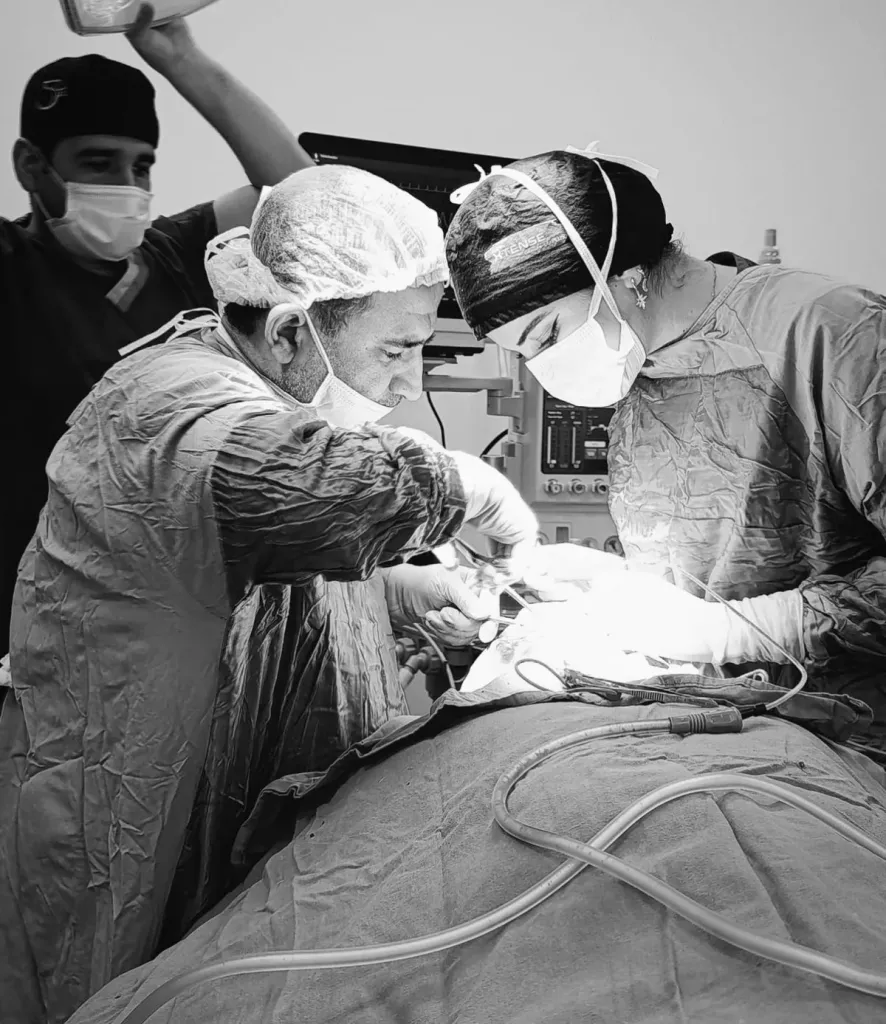
In strabismus surgery the eyes are brought into alignment by changing the attachment point and length of the eye muscles. The eyeball is not taken out of its socket; this popular belief is not true.
- Planning: Based on the cover test and prism measurements, it is decided which muscles will be adjusted and by how many millimeters. A pediatric and anesthesia assessment is done; the anesthesia team tells you how long to fast before surgery.
- Anesthesia: General anesthesia is essential in children. In adults, general anesthesia or local anesthesia with intravenous sedation can be used; in some adult cases the “adjustable suture” technique is preferred, which allows the muscle position to be fine-tuned at the end of the operation.
- Incision: An incision of a few millimeters is made in the thin membrane covering the white of the eye (the conjunctiva); there is no skin incision and no external scar.
- Adjusting the muscles: A muscle that pulls too strongly is detached from its attachment point and stitched further back (recession); a weak muscle is shortened to strengthen it (resection). Depending on the size of the turn, one or more muscles are adjusted in one or both eyes.
- Closure: The conjunctiva is closed with dissolving stitches; an antibiotic drop or ointment is applied.
- Duration and discharge: The procedure takes 30–60 minutes depending on the number of muscles; you go home the same day, a few hours after waking from the anesthesia.
Under general anesthesia nothing is felt during the procedure. After the operation, stinging, a gritty feeling, watering and redness are expected; mild pain passes with simple painkillers. In adult operations done under local anesthesia, brief pressure and aching may be felt while the muscle is being pulled.
How is treatment planned?
Glasses and patching support the development of vision; surgery corrects the position of the eyes.
- Patching treatmentIf there is lazy eye, the better-seeing eye is covered for set periods; as the weaker eye is made to work, the development of vision is supported. The duration is set according to the plan given by the doctor.
- Muscle surgeryTo correct the position of the eye, the relevant muscle is moved back or shortened. The eye is not taken out of its socket; the procedure is done at the site where the muscles attach.
- The intended resultThe aim is to correct the position of the eyes and, as far as possible, to let them work together. In some cases a second operation may be needed.
What is recovery like?
After strabismus surgery the redness largely clears in 2–4 weeks; the final alignment of the eyes is assessed after 6–8 weeks.
- Day 1: There is redness, watering and stinging; the drops are started, and the eye is not rubbed. Children usually return to their normal play the next day; 3–7 days of rest is enough before school.
- Week 1: The stinging decreases; the redness continues. The alignment of the eyes may look variable during this period, and there may be temporary double vision. Swimming and pools are not allowed for 2–3 weeks, dusty environments for 1 week.
- Month 1: The redness has largely disappeared; glasses and patching continue as directed by the doctor. The alignment begins to settle.
- Weeks 6–8 and beyond: The lasting alignment is assessed; if there is under- or over-correction, a second operation is planned after this period. Check-ups are on day 1, at week 1, at month 1 and at months 2–3; after that, lazy eye follow-up continues.
For families coming from districts such as Elbistan, Afşin and Göksun, the check-ups after surgery are spaced out to reduce the burden of travel; in an emergency (sudden pain, increasing swelling, yellow discharge) you should come in without waiting.
What are the risks and limitations?
Strabismus surgery is a commonly performed operation that is considered safe; but like every surgical procedure it has risks and limits:
- Under- or over-correction: The response of the muscles varies from person to person; in some cases a second operation is needed. This is not a failure of the operation but a known part of the treatment.
- Temporary double vision: Especially in adults, it can take a few weeks for the brain to adjust to the new alignment; rarely it can be permanent.
- Infection, bleeding, a cyst or scar on the conjunctiva: Rare; managed with drops and check-ups.
- A muscle slipping out of place, or a perforation of the wall of the eye: Very rare, but serious.
- Anesthesia risks: Anesthesia for children is given by experienced teams; the assessment before anesthesia reduces this risk.
- Recurrence: Especially in intermittent outward turning, the turn can reappear over the years.
- Limitations: The operation does not remove the need for glasses, does not correct lazy eye, and at an older age may not fully restore depth perception with both eyes; surgery done at an early age has the advantage in this respect.
Comparison of treatment options
| Option | When | Pros | Cons |
|---|---|---|---|
| Glasses | Inward turning caused by hyperopia, a difference in refractive error | Not surgical; also treats lazy eye | Must be worn all the time; does not fully correct the turn in every case |
| Patching / penalization | Lazy eye | Improves the vision of the lazy eye | Takes months; the child’s cooperation is essential; can return if stopped early |
| Prisms | Small-angle turn, double vision in adults | Works immediately | Does not correct the turn; the lenses become thicker |
| Botulinum toxin | Recent nerve palsy, small-angle turn, some cases in babies | No incision, short procedure | Effect is temporary; may need repeating; temporary drooping of the lid |
| Strabismus surgery | Constant turn not corrected by glasses, adult strabismus | Aims at lasting alignment; depth perception and appearance improve | General anesthesia; possibility of a second operation |
If the cause of the turn is a droopy eyelid or a congenital cataract, that problem is treated before anything else (droopy eyelid, cataract surgery). Babies born prematurely have a high risk of strabismus and lazy eye; ROP follow-up is described on the retinal diseases page.
Strabismus surgery and children’s eye examinations in Kahramanmaraş
Strabismus surgery, lazy eye treatment and children’s eye examinations from infancy onward are performed by Dr. Nejmi Öztürk at HG Hospital in Kahramanmaraş, Türkiye. Dr. Öztürk is an ophthalmologist working in pediatric ophthalmology, the diagnosis and treatment of retinopathy of prematurity (ROP) and strabismus surgery; the examination with drops, cover test, retinal examination and the operation are all done at the same hospital.
Strabismus examinations and surgery and lazy eye follow-up are generally covered by SGK. HG Hospital is a private hospital contracted with the Turkish social security institution (SGK); patients with valid SGK coverage may use it, although a private-hospital co-payment may apply. Patients without SGK coverage, such as international patients and visitors from abroad, pay privately or through their private or travel health insurance; the hospital checks coverage before treatment. Fee information is given by the hospital after the examination, and insurance coverage is clarified at the consultation.
Families from Elbistan, Afşin, Göksun, Ekinözü and Nurhak come to HG Hospital in Kahramanmaraş for children’s eye examinations and surgery; Dr. Öztürk does not see patients in Elbistan. Travel arrangements for the examination with drops and the surgery plan are described on the patients from Elbistan and the surrounding area page.
Dr. Nejmi Öztürk sees patients at HG Hospital in Kahramanmaraş, Türkiye. For patients travelling from other districts or from abroad, examination, tests and treatment planning can be arranged for the same day.
Hospital switchboard (within Türkiye): 444 46 46 · E-mail: info@nejmiozturk.com · HG Hospital, Üngüt Mevkii, Prof. Dr. Necmettin Erbakan Blv. No:209, Onikişubat / Kahramanmaraş, Türkiye
Frequently asked questions
Is eye turning normal in a baby?
Brief, occasional turning up to the 3rd–4th month of life can be normal. A constant or frequently recurring turn that continues after 4–6 months, and a constant turn always in the same eye at any age, need an examination. Only an examination can tell pseudostrabismus from true strabismus.
Up to what age can lazy eye be treated?
Lazy eye treatment is much more effective before the age of 7–8, and the younger the child, the faster the response. A partial response can also be obtained in older children and adolescents, so treatment is attempted even in cases that are noticed late. A screening examination in the preschool years allows lazy eye to be caught in time.
At what age is strabismus surgery done?
In congenital inward turning, surgery is usually done between 6 months and 2 years of age; early alignment helps binocular vision to develop. In other turns, glasses and lazy eye treatment are completed before surgery, which is planned in the preschool years. In adults there is no age limit.
How long does strabismus surgery take, and is a hospital stay needed?
The operation takes 30–60 minutes depending on the number of muscles adjusted. In children general anesthesia is used; the patient goes home the same day, a few hours after waking up, and an overnight stay is usually not needed.
How many hours a day is patching done?
The duration is set between 2 and 6 hours a day according to the degree of the lazy eye and the child’s age; the doctor increases or reduces it at the check-ups. Near activities such as coloring and puzzles during patching increase the effect. In children who do not tolerate the patch, penalization with drops is used.
Will my child stop needing glasses after strabismus surgery?
No. The operation adjusts the eye muscles; it does not change the eye’s refractive error, so the glasses prescription stays the same and the glasses continue to be worn. The operation does not correct lazy eye either; patching continues for as long as it is needed.
Is strabismus surgery done in adults?
Yes. Adult strabismus — a turn that was not treated in childhood, or one caused by a nerve palsy, thyroid eye disease or injury — can be operated on at any age. The aim is to relieve double vision, correct the head position and align the eyes; in adults there is the option of local anesthesia and adjustable sutures.
Is the eye taken out during strabismus surgery?
No. The operation is done through a small incision in the thin membrane covering the white of the eye, on the muscles outside the eyeball. The eye is not taken out of its socket, and the inside of the eye is not entered.
Is strabismus surgery covered by SGK?
Strabismus examinations and surgery are generally covered by SGK; a private-hospital co-payment may apply. Patients without SGK coverage pay privately or through their private or travel health insurance. Coverage conditions are clarified at the examination.
How much does strabismus surgery cost?
Fee information is given by the hospital after the examination; SGK and private insurance coverage is clarified at the consultation. Because the number of muscles to be adjusted and the type of anesthesia are decided at the examination, it is not possible to give information in advance.
When should my child have an eye examination?
Even without any complaint, an eye examination is recommended in the newborn period, between 6 and 12 months, at age 3 and before starting school. Babies born prematurely are followed separately for ROP. If there is strabismus or a high glasses prescription in the family, the examination should not be delayed.
Where are children’s eye examinations done in Kahramanmaraş?
Dr. Nejmi Öztürk examines babies and children at HG Hospital in Onikişubat; families coming from Elbistan, Afşin and Göksun should set aside half a day for the examination with drops. Appointment details are on the contact page.
Sources
- Turkish Ophthalmological Society — todnet.org
- American Academy of Ophthalmology (AAO) — aao.org
- National Eye Institute (NEI) — nei.nih.gov
Related pages
This page is for information only; diagnosis and treatment decisions are made after an examination. The results of any surgical or interventional procedure may vary from person to person. You are advised to obtain detailed advice from your physician before any procedure.
Ophthalmologist and eye surgeon. Graduate of Erciyes University Faculty of Medicine; completed his residency at Ankara Atatürk Training and Research Hospital. With 21 years of experience in cataract and refractive surgery, strabismus, glaucoma, retina and oculoplastic surgery, he sees patients at HG Hospital in Kahramanmaraş, Türkiye. Biography and training
Dr. Nejmi Öztürk
Ophthalmologist and eye surgeon
HG Hospital, Üngüt Mevkii, Prof. Dr. Necmettin Erbakan Blv. No:209, Onikişubat / Kahramanmaraş
+90 506 377 47 68WhatsAppAppointment formHospital switchboard (within Türkiye): 444 46 46 · info@nejmiozturk.com
- Private patients and private health insurance are welcome; patients with SGK coverage may use it (conditions are confirmed by the hospital)
- Same-day examination and test planning for patients travelling from other districts or from abroad
- Getting here and patient information
- Patients from Elbistan and the region