Lens Surgery — Cataract and Intraocular Lens Options
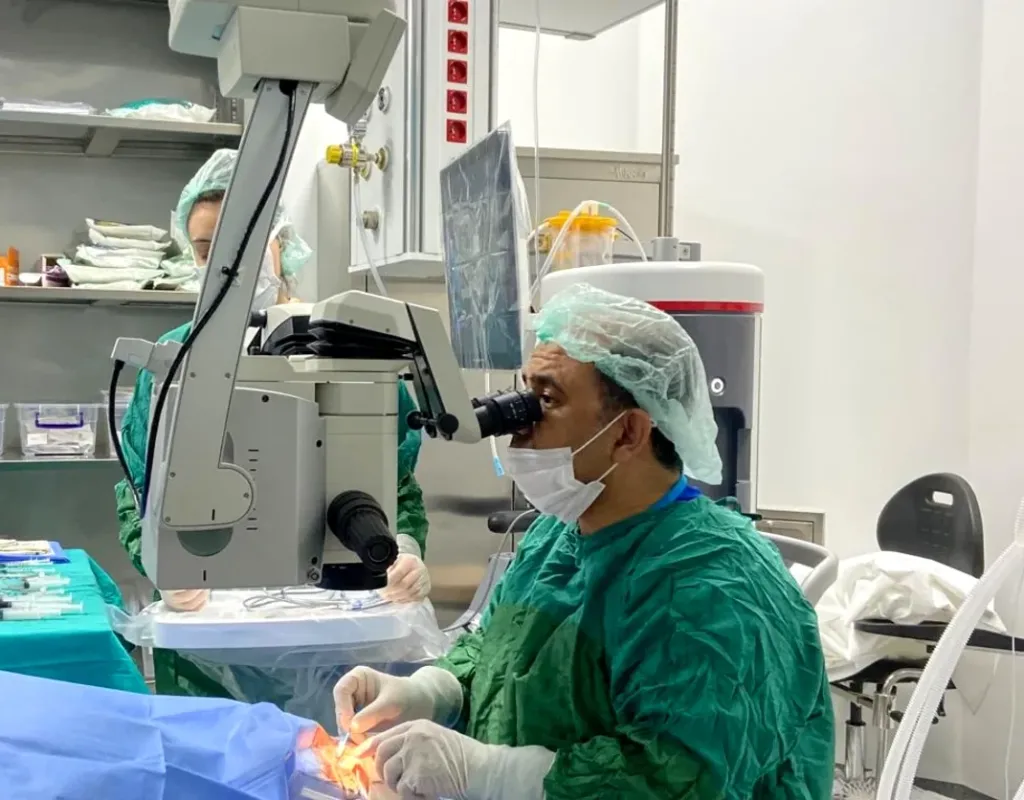
Dr. Nejmi Öztürk, ophthalmologist and eye surgeon, at HG Hospital in Kahramanmaraş, Türkiye — cataract surgery and an objective comparison of monofocal, toric, EDOF and trifocal intraocular lenses and ICL
- Lens surgery removes the eye’s natural lens and replaces it with an artificial intraocular lens; it is done for cataract, or to reduce dependence on glasses in people with a high prescription or age-related near-vision loss.
- There are four main lens types: monofocal, toric, EDOF and trifocal (multifocal, known locally as the “smart lens”). With ICL, your own lens is preserved.
- The examination, the day of surgery, recovery and risks are summarized here; the details are on the sub-pages.
- Cataract surgery is performed by Dr. Öztürk at HG Hospital; suitability for trifocal, EDOF and ICL lenses is assessed with the examination and measurements.
What is lens surgery?
Lens surgery is the removal of the natural lens inside the eye through a small incision and its replacement with a permanent artificial intraocular lens. The eye’s lens is a clear structure that sits just behind the iris (the colored part of the eye) and focuses light onto the retina (the light-sensitive layer at the back of the eye). In youth it is flexible and shifts focus between far and near; after the age of 40 it stiffens (presbyopia, meaning difficulty seeing up close), and in later life it becomes cloudy (cataract, a clouding of the lens).
The surgical technique is the same in every case: in a method called phacoemulsification, the lens is broken up with ultrasound waves and removed, and a foldable lens is put in its place. If the lens is cloudy, this is called cataract surgery; if a clear lens is replaced solely to correct the prescription, it is called refractive lens exchange.
Who is lens surgery for?
Lens surgery is performed in three main groups: people with cataract, people with a high prescription for whom laser is not suitable, and people over 45 who want to be free of reading glasses.
Cataract
Cataract is the most common reason for lens surgery. A lens that has become cloudy cannot be corrected with glasses; surgery is planned when vision starts to make daily life difficult. By choosing the lens type, astigmatism or a near-vision problem can be corrected in the same session.
Refractive lens exchange for high prescriptions and presbyopia
Refractive lens exchange is the replacement of the clear lens with a multifocal lens in people who do not have a cataract but want to be free of glasses. It is usually considered in people over 45 whose near vision has started to deteriorate and, in particular, who have high hyperopia (farsightedness, difficulty seeing both near and far). It is also an option for patients whose corneal thickness or prescription is not suitable for laser eye surgery. In these people a trifocal (multifocal) lens or an EDOF lens is preferred; in young, highly myopic patients, ICL comes to the fore because it preserves the natural lens.
Who is it not suitable for?
Lens surgery is postponed in people with an active eye infection or uncontrolled inflammation inside the eye. In young, highly myopic people without a cataract, removing the clear lens is generally not recommended because it increases the risk of retinal detachment (separation of the retina); ICL is assessed in this group. Multifocal lenses are not suitable for people with macular degeneration, advanced glaucoma (high eye pressure) or an irregular cornea; if a cataract is present, a monofocal lens is used. Lens exchange for refractive purposes is not done in people whose prescription has not yet stabilized.
What is measured at the pre-operative examination and biometry?
Before lens surgery, biometry measurements are taken together with an eye examination; the power and type of the lens to be implanted are determined from these measurements. At the examination, visual acuity and eye pressure are assessed, and the retina and macula are examined with the pupil dilated.
- Optical biometry: The length of the eye from front to back and the curvature of the cornea are measured; the lens power is calculated.
- Corneal topography: The amount of astigmatism and whether it is regular are determined; the decision on a toric lens and suitability for a multifocal lens are based on this.
- OCT (optical coherence tomography of the eye): The macula and the layers of the retina are examined; diseases that rule out a multifocal lens are detected.
- Endothelial cell count: The number of cells on the inner surface of the cornea is measured; this is mandatory particularly in patients for whom ICL is planned.
- Anterior chamber depth and pupil measurement: For ICL, the space the lens will fit into is assessed; for a multifocal lens, the pupil diameter in dim light.
If you wear contact lenses, you will be asked to leave soft lenses out for at least one week before the measurements and rigid lenses for longer; otherwise the corneal measurements will be misleading. Be sure to mention any blood thinners and prostate medicines at the examination.
How is lens surgery performed?
Lens surgery is done with anesthetic eye drops, through an incision of about 2–3 mm, usually in 15–30 minutes, and you go home the same day. The day of surgery runs as follows:
- Drops that dilate the pupil and numb the eye are applied; the area around the eye is cleaned.
- A small incision is made at the edge of the cornea; a round opening is created in the front surface of the membrane that surrounds the lens.
- The lens is broken up with a fine probe that delivers ultrasound energy and is removed by suction; the back membrane is left in place.
- The foldable artificial lens is delivered with an injector, unfolds inside the membrane and settles into position; with a toric lens the axis is aligned.
- The incision seals by itself; stitches are usually not needed. A protective shield is placed over the eye.
During the procedure you feel light, mild pressure and touch. The steps are different in ICL surgery: the natural lens is not removed, and a thin lens is placed between the iris and the lens. Because you cannot drive on the day of surgery, you need to come to the hospital with a companion.
Lens surgery step by step
Removal of the natural lens and placement of an intraocular lens, shown schematically on a cross-section of the front of the eye.
- Small incisionAn incision of about 2–3 mm is made at the edge of the cornea. Because it closes by itself, stitches are not needed in most cases.
- Opening the front capsuleA circular opening is made in the front of the transparent capsule that surrounds the lens. The rest of the capsule is preserved as the bed for the new lens.
- Breaking up and removing the lensUltrasound energy breaks the lens into small pieces, which are removed by suction through the same incision.
- Placing the intraocular lensThe lens is inserted in folded form, unfolds inside the capsular bag and stays centred by its own haptics.
What types of intraocular lens are there?
Intraocular lenses are divided into four main groups according to the distance they focus on and whether they correct astigmatism. The table below summarizes what each means in daily life; the choice is made together at the examination according to the health of your eye, your occupation and your expectations.
| Lens type | Distance | Intermediate (computer, kitchen) | Near (reading, phone) | Night halos and glare | Need for glasses | SGK coverage |
|---|---|---|---|---|---|---|
| Monofocal | Clear | Limited | With glasses | Low | Needed for near | Standard lens is covered |
| Toric | Clear; astigmatism corrected | Limited | With glasses | Low | Needed for near | A lens surcharge may apply |
| EDOF | Clear | Clear | Sufficient for large print; glasses may be needed for small print | Low–moderate | Occasionally | Lens surcharge paid by the patient |
| Trifocal (multifocal) | Clear | Clear | Clear | Moderate; decreases over time | Usually not needed | Lens surcharge paid by the patient |
Every lens type also has a toric (astigmatism-correcting) option. For details, see the cataract surgery (monofocal and toric lens), trifocal lens (multifocal intraocular lens) and EDOF lens pages.
How is the phakic ICL different?
The ICL (phakic intraocular lens) is a thin lens placed between the iris and the natural lens without removing the natural lens; in other words, your own lens is preserved. This means the lens keeps its ability to shift focus between far and near, and the ICL can be removed if necessary. It is considered in people aged 21–45 with high myopia (nearsightedness, difficulty seeing far away), a thin cornea or dry eye, for whom laser is not suitable. The anterior chamber depth and the endothelial cell count must be sufficient for the lens to fit; yearly follow-up is needed for cataract development and eye pressure. Detailed information is on the ICL surgery page.
How do lens types differ?
The same operation with a different lens choice: how the focal points are distributed on the retina.
- Monofocal lensFocuses on a single distance. It is usually planned for clear distance vision; reading glasses are needed for near.
- Trifocal lensDistributes incoming light to three focal points: far, intermediate and near. Dependence on glasses is reduced for most everyday tasks.
- EDOF lensFocuses not on a single point but over an extended range. It gives continuity at far and intermediate distances; glasses may be needed for very close work.
What is recovery like after surgery?
After lens surgery, vision clears from day 1 in most patients and settles within a few weeks. Check-ups are on the day after surgery, at week 1 and at month 1; with multifocal lenses, a month 3 check-up may be added for the brain’s adaptation (neuroadaptation).
- Day 1: The protective shield is removed; eye pressure and the position of the lens are checked. Antibiotic and anti-inflammatory drops are started. Mild stinging, watering and haziness are normal.
- Week 1: Do not rub the eye, keep water out of it and do not lift heavy objects. Reading and television are allowed; you can return to desk work within a few days.
- Month 1: The drops are tapered and stopped. You usually wait a month before swimming pools, the sea and the hammam (Turkish bath). If a permanent glasses prescription is needed, it is measured at week 3–4.
For patients coming from Elbistan, Afşin, Göksun, Ekinözü and Nurhak, the day of surgery and the day 1 check-up are planned together; the later check-ups are spaced out according to travel conditions.
What are the risks and limitations of lens surgery?
Lens surgery is a frequently performed operation with well-known results; serious problems are rare, but as with every operation there are risks, and you need to know them in advance.
- Infection: Rare, but it requires urgent treatment; increasing pain, redness and reduced vision are warning signs.
- Posterior capsule opacification (secondary cataract): The membrane the lens sits in can become cloudy over months to years; it is cleared with a YAG laser procedure lasting a few minutes.
- Macular edema and corneal edema: Can cause temporary blurring; they usually resolve with drop treatment.
- Refractive surprise: A small glasses prescription may remain; it is corrected with glasses or an additional procedure.
- Specific to multifocal lenses: Halos and glare around lights at night, reduced contrast in dim light; these usually decrease within months, and rarely a lens exchange may be needed.
- Specific to refractive lens exchange: The risk of retinal detachment in highly myopic people; for this reason it is not preferred in young myopic patients.
- Specific to ICL: Cataract development, a rise in eye pressure and endothelial cell loss; it requires yearly follow-up.
As a limitation, no lens exactly reproduces the natural focusing ability of a young eye. If there is macular or retinal disease, vision improves only as far as these diseases allow; multifocal lenses are not recommended in these diseases.
Sub-pages: what is on which page?
- Cataract surgery: Symptoms, the steps of surgery, monofocal and toric lenses, the recovery timeline, insurance coverage, secondary cataract.
- Trifocal lens (multifocal intraocular lens): Who it suits, what to expect regarding freedom from glasses, night halos and the adaptation period.
- EDOF lens: The extended-depth-of-focus principle, comparison with trifocal, assessment for people who drive at night.
- ICL (phakic intraocular lens): The option that preserves your own lens for highly myopic people who cannot have laser; measurements, risks and follow-up.
- Laser eye surgery: Methods that reshape the cornea instead of the lens.
Assessment and planning in Kahramanmaraş
In Kahramanmaraş, Türkiye, cataract surgery with monofocal and toric lenses is performed by Dr. Nejmi Öztürk in the Ophthalmology Department of HG Hospital. Dr. Öztürk is an ophthalmologist working in cataract and refractive surgery. Your suitability for a trifocal (multifocal) lens, an EDOF lens or ICL is assessed with the examination and measurements at HG Hospital in Kahramanmaraş; the method that suits you is planned together.
HG Hospital is a private hospital contracted with the Turkish social security institution (SGK); patients with valid SGK coverage may use it, although a private-hospital co-payment may apply. For these patients, cataract surgery with a standard monofocal lens falls within SGK coverage; if a toric, EDOF or trifocal lens is chosen, the lens surcharge is paid by the patient, and lens exchange for refractive purposes and ICL are generally not covered by SGK. Patients without SGK coverage, such as international patients and visitors from abroad, pay privately or through their private or travel health insurance; the hospital checks coverage before treatment. Fee information is given by the hospital after the examination, and insurance coverage is clarified at the consultation.
Dr. Öztürk does not see patients in Elbistan; patients from Elbistan, Afşin, Göksun, Ekinözü and Nurhak come to HG Hospital in Kahramanmaraş. The examination and all measurements are completed on the same day; travel and planning information is on the patients from Elbistan and the surrounding area page.
Cataract and lens planning with RLES AI
In cataract and intraocular lens planning, Op. Dr. Nejmi Öztürk uses RLES AI, an explainable artificial intelligence (XAI)-based clinical decision support system, as a second layer of analysis. The system does not calculate the lens power and does not recommend a brand or model; it checks the accuracy of the data that enter the calculation and the patient’s suitability.
- True corneal power: Corneal refractive power is compared across independent layers of measurement; a mismatch between measurements is flagged as a finding.
- Data for the toric decision: The posterior corneal astigmatism is also taken into account.
- Suitability and risk screening: Suitability at the level of the lens class and the surgical risk profile are assessed; screening is carried out for glaucoma and dry eye.
- Special eyes: In eyes that have had laser before, in very short or very long eyes and in eyes with keratoconus, it determines which calculation method should be prioritized.
This assessment does not replace the physician’s decision; your physician makes the treatment decision and the plan together with the examination findings. RLES AI is a clinical decision support application and is intended solely for use by physicians.
Dr. Nejmi Öztürk sees patients at HG Hospital in Kahramanmaraş, Türkiye. For patients travelling from other districts or from abroad, examination, tests and treatment planning can be arranged for the same day.
Hospital switchboard (within Türkiye): 444 46 46 · E-mail: info@nejmiozturk.com · HG Hospital, Üngüt Mevkii, Prof. Dr. Necmettin Erbakan Blv. No:209, Onikişubat / Kahramanmaraş, Türkiye
Frequently asked questions
Are lens surgery and cataract surgery the same thing?
Technically yes; in both, the natural lens is removed and replaced with an artificial lens. If the lens is cloudy it is called cataract surgery; if a clear lens is replaced solely to correct the prescription it is called refractive lens exchange. Insurance coverage differs according to this distinction.
Does an intraocular lens have a lifespan; will it need to be replaced?
Intraocular lenses are made to last a lifetime and are not replaced under normal circumstances. Rarely, replacement may be needed because the lens has shifted, because of halos that cannot be tolerated or because of an incorrect power. Clouding of the membrane the lens sits in is cleared with a laser; the lens is not replaced.
Which lens is right for me, and how is the decision made?
The decision depends on whether a cataract is present, the amount of astigmatism, the health of the retina and cornea, the pupil diameter, your occupation and whether you drive at night. A trifocal lens comes to the fore for people with healthy eyes who want to be largely free of glasses, EDOF for those who prioritize night driving and intermediate distance, and monofocal for those with additional eye disease. The final decision is made together after the examination and measurements.
At what age is lens surgery done?
There is no age limit for cataract; surgery is done when vision affects daily life. Lens exchange for refractive purposes is usually considered over the age of 45. In young, highly myopic people, ICL, which preserves your own lens, is preferred.
Are both eyes operated on the same day?
In cataract surgery the eyes are usually operated on separate days; the interval is planned between a few days and a few weeks. With multifocal lenses, operating on the two eyes close together makes the brain’s adaptation easier. With ICL, the two eyes can be done on the same day or on separate days.
How much does lens surgery cost, and does insurance cover it?
For patients with valid SGK coverage, cataract surgery with a standard monofocal lens is covered; a private-hospital co-payment may apply. With multifocal lenses the lens surcharge is paid by the patient; refractive lens exchange and ICL are generally not covered. Patients without SGK coverage pay privately or through their private or travel health insurance. Fee information is given by the hospital after the examination; insurance coverage is clarified at the consultation.
Where should I go for lens surgery in Kahramanmaraş?
Dr. Nejmi Öztürk sees his patients at HG Hospital in Onikişubat, Kahramanmaraş. Cataract surgery is performed at this hospital; suitability for trifocal, EDOF and ICL lenses is assessed with the examination and measurements. You can use the contact section on this page to make an appointment.
I am coming from Elbistan; how many days do the examination and surgery take?
The examination and biometry measurements are usually completed on the same day; the surgery is planned for a separate day. The day of surgery and the next day’s check-up are arranged together; if you wish, you can stay one night in Kahramanmaraş. Because the journey takes about 2 hours, you need to come with a companion who will drive after the surgery.
Sources
- Turkish Ophthalmological Society — todnet.org
- American Academy of Ophthalmology (AAO) — aao.org
- European Society of Cataract and Refractive Surgeons (ESCRS) — escrs.org
- National Eye Institute (NEI) — nei.nih.gov
Related pages
- Cataract surgery
- Trifocal lens (multifocal intraocular lens)
- ICL (phakic intraocular lens) surgery
- Laser eye surgery
This page is for information only; diagnosis and treatment decisions are made after an examination. The results of any surgical or interventional procedure may vary from person to person. You are advised to obtain detailed advice from your physician before any procedure.

Ophthalmologist and eye surgeon. Graduate of Erciyes University Faculty of Medicine; completed his residency at Ankara Atatürk Training and Research Hospital. With 21 years of experience in cataract and refractive surgery, strabismus, glaucoma, retina and oculoplastic surgery, he sees patients at HG Hospital in Kahramanmaraş, Türkiye. Biography and training
Dr. Nejmi Öztürk
Ophthalmologist and eye surgeon
HG Hospital, Üngüt Mevkii, Prof. Dr. Necmettin Erbakan Blv. No:209, Onikişubat / Kahramanmaraş
+90 506 377 47 68WhatsAppAppointment formHospital switchboard (within Türkiye): 444 46 46 · info@nejmiozturk.com
- Private patients and private health insurance are welcome; patients with SGK coverage may use it (conditions are confirmed by the hospital)
- Same-day examination and test planning for patients travelling from other districts or from abroad
- Getting here and patient information
- Patients from Elbistan and the region