Eye Doctor in Kahramanmaraş – Dr. Nejmi Öztürk
Dr. Nejmi Öztürk, ophthalmologist and eye surgeon — eye examinations for adults and children, medical and surgical treatment at HG Hospital in Onikişubat, Kahramanmaraş, Türkiye
- Dr. Nejmi Öztürk is an ophthalmologist and eye surgeon with 21 years of experience; since 2025 he has been seeing patients at HG Hospital in Kahramanmaraş (Onikişubat).
- You can come with complaints such as blurred vision, high eye pressure, eye problems related to diabetes, a turned eye in a child, a droopy eyelid, watering, redness and dryness.
- Examinations are by appointment; because near vision stays blurred for 4–6 hours after an examination with dilating drops, you are advised not to drive and to bring someone with you.
- HG Hospital is a private hospital contracted with the Turkish social security institution (SGK); private health insurance is accepted, and patients without SGK coverage pay privately or through their private or travel insurance. Coverage conditions are clarified at the consultation.
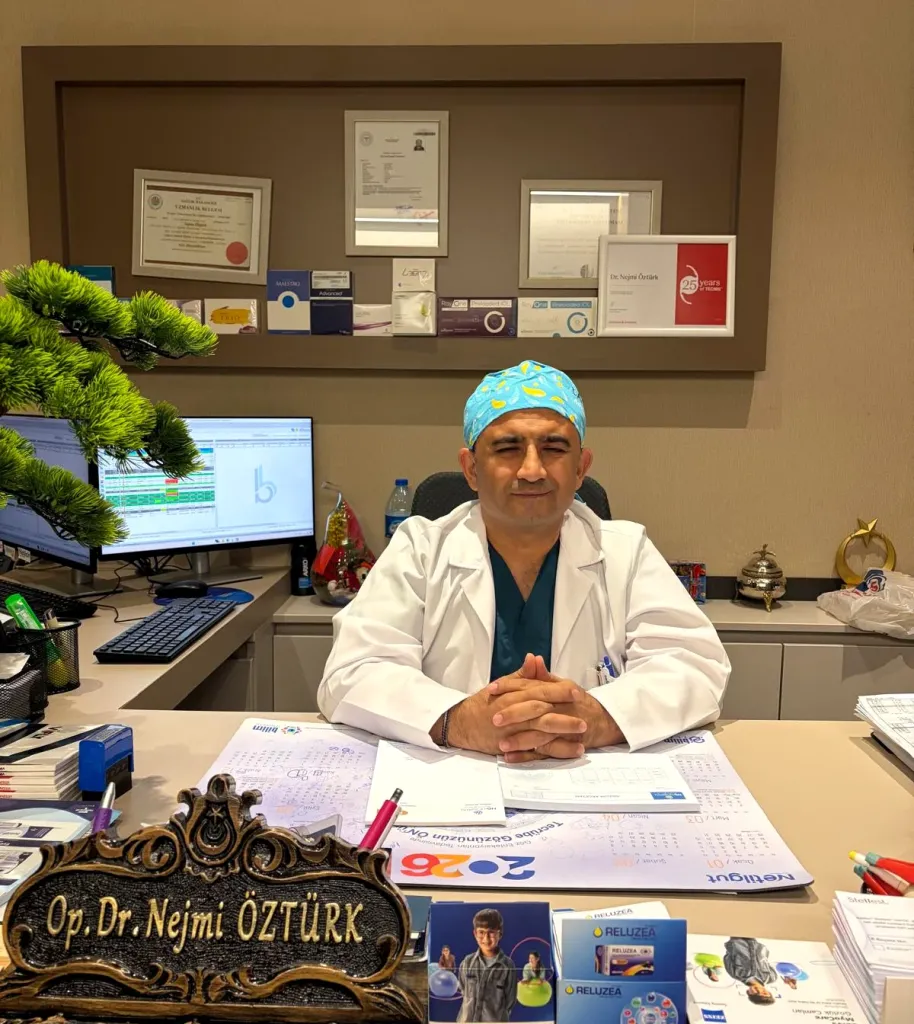
Who is Dr. Nejmi Öztürk?
Dr. Nejmi Öztürk, ophthalmologist and eye surgeon, works in the fields of cataract and refractive surgery, strabismus, glaucoma, retina and oculoplastic surgery. He was born in 1979; after Elbistan Anadolu Lisesi (high school) he completed his medical training at Erciyes University Faculty of Medicine and his residency in ophthalmology at Ankara Atatürk Training and Research Hospital. After his compulsory state service he worked in private hospitals; he has 21 years of professional experience.
Since 2025 he has been seeing patients in the Ophthalmology department of HG Hospital in Kahramanmaraş. He is originally from Elbistan, but he does not see patients in Elbistan. For details of his training, publications and areas of work, see the About Dr. Nejmi Öztürk page.
Which complaints can you come with?
You can come with any complaint about your vision, and also for a routine check-up even if you have no symptoms. Common complaints and the related information pages:
- Blurred, hazy or yellowed vision; difficulty driving at night: This may be a cataract (clouding of the lens of the eye) — cataract surgery, lens surgery
- Not being able to see far or near without glasses or contact lenses: Myopia, hyperopia, astigmatism, age-related loss of near vision — laser eye surgery (laser vision correction), trifocal lens
- A family history of glaucoma, a check-up after the age of 40, narrowing of side vision: Glaucoma (high eye pressure) — glaucoma
- Diabetes: A retinal examination is needed once a year even if there are no symptoms — diabetic retinopathy, retinal diseases
- A spot in the center of vision, straight lines looking wavy, floaters, flashes of light: Macular degeneration or a retinal tear — macular degeneration
- A turned eye in a child, squinting, tilting the head to one side to look: Strabismus and lazy eye — strabismus and lazy eye
- A drooping or sagging eyelid, tilting the head back to see: Ptosis (droopy eyelid) — blepharoplasty and ptosis
- Constant watering and discharge: Blocked tear duct — blocked tear duct
- Redness, pain, sensitivity to light: Uveitis, corneal inflammation or blepharitis (inflammation of the eyelid margins) — uveitis (uveal diseases), corneal diseases, blepharitis
- Stinging, burning, a gritty feeling, tired eyes at the screen: dry eye
- Tissue growing from the white of the eye onto the cornea: pterygium (surfer’s eye)
- Frequent changes in your glasses prescription, lights appearing scattered: This may be keratoconus — keratoconus treatment
- Eye examinations for babies and children: ROP screening in premature babies, pre-school vision screening — see the “Children and babies” section below
Short summaries of these conditions are brought together on the eye diseases and treatments page.
How do you get to HG Hospital?
HG Hospital is in the Onikişubat district of Kahramanmaraş, Türkiye, at Üngüt Mevkii, Prof. Dr. Necmettin Erbakan Bulvarı No:209. Dr. Nejmi Öztürk sees patients only at this hospital; he has no other practice or branch. Entering the hospital’s address into your navigation app is enough to find it.
- City center, Onikişubat and Dulkadiroğlu: The hospital is in the provincial center; you can reach it by car, taxi or public transport. Confirm the public transport route and stop with the hospital when booking your appointment.
- Türkoğlu, Pazarcık, Andırın and Çağlayancerit: Take the main road that connects to the provincial center and continue to Onikişubat; the travel time depends on the district and the weather. Since tests may also be done, allow plenty of time before your return.
- Göksun, Afşin, Elbistan, Ekinözü and Nurhak: Göksun–Kahramanmaraş is about 78 km, Afşin–Kahramanmaraş about 123 km and Elbistan–Kahramanmaraş about 148 km (about 2 hours, via Göksun). Ekinözü and Nurhak are districts close to Elbistan. Travel, appointment and follow-up information prepared for people coming from these districts is on the patients from Elbistan and the surrounding area page.
Parking, consultation days and hours can change, so they are not listed on this page; confirm them with the hospital when booking your appointment.
How do you make an appointment?
You are advised to book an appointment in advance; this shortens the waiting time and allows the necessary tests to be planned for the same day. To book, use one of the options in the contact block on this page — telephone, WhatsApp or the appointment form; the same details are also on the contact page. If you need help communicating in English, ask the hospital when booking.
Giving the following information when you book makes planning easier: your complaint, whether you have had eye surgery before, whether you have diabetes or high blood pressure, which district you will be coming from, and whether you will be using SGK, private or travel insurance or paying privately. If you are coming from a distant district, ask for a morning appointment. If you are coming for a laser eye surgery assessment, you need to stop wearing soft contact lenses 1 week and rigid (gas-permeable) lenses 2–3 weeks beforehand; choose your appointment date accordingly.
What to expect at your first visit
The first examination usually takes 30–60 minutes; if drops that widen the pupil are used, a 20–30 minute wait is added for them to take effect. The examination proceeds in the following order:
- History: You are asked about your complaint, how long it has lasted, the medicines you take, the operations you have had and eye diseases in your family.
- Vision and prescription measurement: Your visual acuity is measured; if needed, your glasses prescription is determined (refraction).
- Eye pressure measurement: Done with an air-puff device or, after numbing drops, with a contact method; you feel a light puff of air or a brief touch.
- Slit-lamp examination: The eyelids, cornea (the clear front layer), the lens of the eye and the front segment are examined under magnification.
- Dilated retinal examination: If considered necessary, drops that widen the pupil are applied; the retina and the optic nerve are examined.
- Additional tests: Depending on the complaint, tests such as OCT (retina and nerve fiber tomography), corneal topography, a visual field test and biometry (lens measurement) are done on the same day whenever possible.
- Assessment and plan: The findings are explained in plain language; the treatment options, the follow-up date and, if needed, the surgical plan are decided together.
After an examination with dilating drops, near vision stays blurred for 4–6 hours and light is uncomfortable. Do not drive during this time; if possible, bring someone with you, and bring sunglasses.
What should you bring to the examination?
What to bring to the examination:
- Your identity card or passport; if you have private insurance, your policy details
- The glasses you wear and your latest glasses prescription, if you have one
- A list of all the medicines you take regularly (including medicines containing cortisone and blood thinners)
- Previous eye examination reports; OCT, corneal topography and visual field printouts
- If you have diabetes, your latest HbA1c result (three-month average blood sugar)
- If you wear contact lenses, your lens box; for a laser assessment, you should already have stopped wearing your lenses
- Sunglasses and, in case dilating drops are used, someone to accompany you
- For children, previous eye reports; for premature babies, the newborn discharge summary
Eye examinations for children and babies
A child’s eyes should be examined at 6–12 months, at 3–4 years and before starting school, even if there are no symptoms, because lazy eye (amblyopia) can be treated only in childhood. Dr. Nejmi Öztürk works in pediatric ophthalmology, strabismus surgery and the diagnosis and treatment of retinopathy of prematurity (ROP).
- ROP screening in premature babies: In premature and low-birth-weight babies the retinal blood vessels may not be fully developed; a retinal examination carried out on the schedule set by the newborn doctor, with laser or an injection when needed, protects vision. The screening appointment should not be delayed.
- Strabismus: An eye turn that persists after 4–6 months of age in babies, intermittent turning in children and tilting the head to one side to look all need an examination. Treatment consists of glasses, patching and, when necessary, surgery.
- Lazy eye: A child does not notice that one eye sees less; if it is caught at the pre-school screening, treatment is usually effective. Treatment becomes more difficult after the age of 7–8.
- Congenital blocked tear duct: A common cause of watering and discharge in babies; most open with massage, and if not, a short probing procedure is done.
In children the glasses prescription is measured with drops that relax the focusing muscle; the effect of the drops can last 1–3 days, so plan for a day off school. Details are on the strabismus and lazy eye page.
SGK, private and travel health insurance
HG Hospital is a private hospital contracted with the Turkish social security institution (SGK); patients with valid SGK coverage may use it for examinations and treatment, although a private-hospital co-payment may apply. Private health insurance policies are also accepted. Patients without Turkish social security coverage, such as international patients, expatriates and visitors from abroad, pay privately or through their private or travel health insurance; the hospital confirms coverage before treatment.
| Treatment | SGK coverage (general information) |
|---|---|
| Eye examination and tests | Generally covered; a co-payment may apply |
| Cataract surgery (standard monofocal lens) | Covered; if a trifocal or EDOF (multifocal) lens is chosen, the lens surcharge is paid by the patient |
| Glaucoma, retina (injection, laser, vitrectomy), strabismus, DCR (tear duct surgery), pterygium, uveitis | Generally covered |
| Laser eye surgery (laser vision correction), ICL, lens exchange for a trifocal lens | Usually not covered |
| Cosmetic blepharoplasty | Not covered; ptosis that restricts vision may be covered under certain conditions |
| Cross-linking (CXL) for keratoconus | May be covered under certain conditions; intracorneal ring segments are not covered |
Coverage conditions and any co-payment are clarified by the hospital at the consultation; fee information is given by the hospital after the examination and is not published on this page.
Dr. Nejmi Öztürk sees patients at HG Hospital in Kahramanmaraş, Türkiye. For patients travelling from other districts or from abroad, examination, tests and treatment planning can be arranged for the same day.
Hospital switchboard (within Türkiye): 444 46 46 · E-mail: info@nejmiozturk.com · HG Hospital, Üngüt Mevkii, Prof. Dr. Necmettin Erbakan Blv. No:209, Onikişubat / Kahramanmaraş, Türkiye
Frequently asked questions
Do I need an appointment for an eye examination in Kahramanmaraş?
You are advised to book an appointment; this shortens the waiting time and allows the necessary tests to be planned for the same day. Ask the hospital about the conditions for walk-in visits. In an emergency, go to the emergency department without waiting for an appointment.
Can I drive after an examination with dilating drops?
No. The drops that widen the pupil blur near vision for 4–6 hours and cause sensitivity to light. On the day of the examination, have a relative or friend drive, or come by public transport.
How long does the examination take?
The examination usually takes 30–60 minutes. A 20–30 minute wait is needed for a dilated retinal examination, and extra time for tests such as OCT or a visual field test. It is sensible to plan on spending half a day at the hospital.
Is laser eye surgery available in Kahramanmaraş?
Your suitability for laser eye surgery is assessed with the examination and measurements at HG Hospital in Kahramanmaraş (corneal topography, corneal thickness, pupil diameter, tear tests); the method that suits you is planned together. Before the assessment you need to stop wearing soft lenses for 1 week and rigid lenses for 2–3 weeks. The methods are explained on the laser eye surgery page.
Are patients with SGK (Turkish social security) accepted?
Yes. HG Hospital is a private hospital contracted with the Turkish social security institution (SGK); examinations and treatments can be carried out within SGK coverage, although a private-hospital co-payment may apply. The coverage conditions are explained by the hospital before the examination. Patients without SGK coverage pay privately or through their private or travel health insurance.
Are there consultations in Elbistan?
No. Dr. Nejmi Öztürk is originally from Elbistan but does not see patients there; all examinations and operations take place at HG Hospital in Kahramanmaraş. Information prepared for people coming from Elbistan and the surrounding districts is on the patients from Elbistan and the surrounding area page.
I am looking for an eye doctor in Onikişubat; where exactly is the hospital?
HG Hospital is in the Onikişubat district at Üngüt Mevkii, Prof. Dr. Necmettin Erbakan Bulvarı No:209. Entering this address into your navigation app is enough.
Where can I find out the fees for the examination and tests?
Fee information is given by the hospital after the examination; SGK, private and travel insurance coverage is clarified at the consultation. Under Turkish regulations, fee information is not published on this website.
At what age do eye examinations for babies start?
An examination at 6–12 months is recommended even if there are no symptoms; the next examinations are at 3–4 years and before starting school. In premature babies, ROP screening starts much earlier, on the schedule set by the newborn doctor. If there is an eye turn, squinting or discomfort in light, do not wait for these ages.
I have diabetes and my vision is fine; should I still see an eye doctor?
Yes. Retinal damage caused by diabetes produces no symptoms for a long time; by the time vision deteriorates, the damage may already be advanced. If there is no retinopathy, a dilated retinal examination once a year is recommended; details are on the diabetic retinopathy page.
Can cataract surgery be done on the same day as the examination?
No. First the examination and the biometry measurement that determines the lens power are done; time is also needed to adjust blood thinners and to complete the insurance paperwork. Surgery is planned for a separate day; details are on the cataract surgery page.
I have private health insurance; can I use it at HG Hospital?
Yes; HG Hospital works with private health insurance companies. Find out from your insurer in advance whether your policy covers eye examinations, tests and surgery and whether pre-authorization is required. If you have travel or international health insurance, the hospital checks your coverage before treatment.
Sources
- Turkish Ophthalmological Society — todnet.org
- American Academy of Ophthalmology (AAO) — aao.org
- National Eye Institute (NEI) — nei.nih.gov
Related pages
- Dr. Nejmi Öztürk: training and areas of specialization
- Information for patients from Elbistan and the surrounding area
- Eye diseases and treatments
- Frequently asked questions
This page is for information only; diagnosis and treatment decisions are made after an examination. The results of any surgical or interventional procedure may vary from person to person. You are advised to obtain detailed advice from your physician before any procedure.
Ophthalmologist and eye surgeon. Graduate of Erciyes University Faculty of Medicine; completed his residency at Ankara Atatürk Training and Research Hospital. With 21 years of experience in cataract and refractive surgery, strabismus, glaucoma, retina and oculoplastic surgery, he sees patients at HG Hospital in Kahramanmaraş, Türkiye. Biography and training
Dr. Nejmi Öztürk
Ophthalmologist and eye surgeon
HG Hospital, Üngüt Mevkii, Prof. Dr. Necmettin Erbakan Blv. No:209, Onikişubat / Kahramanmaraş
+90 506 377 47 68WhatsAppAppointment formHospital switchboard (within Türkiye): 444 46 46 · info@nejmiozturk.com
- Private patients and private health insurance are welcome; patients with SGK coverage may use it (conditions are confirmed by the hospital)
- Same-day examination and test planning for patients travelling from other districts or from abroad
- Getting here and patient information
- Patients from Elbistan and the region