EDOF (Extended Depth of Focus) Intraocular Lens
Objective information about the extended depth of focus intraocular lens — suitability is assessed with the examination and measurements of Dr. Nejmi Öztürk, ophthalmologist and eye surgeon, at HG Hospital in Kahramanmaraş, Türkiye
- An EDOF (extended depth of focus) lens provides a continuous range of clear vision from distance to intermediate; glasses may be needed for small print.
- How it differs from the trifocal (multifocal) lens: near vision is more limited, night halos and glare are fewer, and contrast is higher.
- It is considered for people who drive at night and those who prioritize computer distance; the macula and cornea must be healthy.
- The lens surcharge is not covered by SGK; suitability is assessed with the examination and measurements.
What is an EDOF lens?
An EDOF lens (extended depth of focus lens) is an intraocular lens that creates an extended range of focus instead of splitting light into separate focal points. A monofocal lens gives clear vision at one distance and a trifocal lens at three separate distances; an EDOF lens provides continuous clarity starting from distance and extending to intermediate range (about 60–80 cm). For this reason it is also referred to as an “extended focus lens”.
EDOF lenses come in different designs (diffractive rings, surfaces that shape the wavefront, the small-aperture principle); the common aim is to provide glasses-free vision at distance and intermediate range without splitting light into many focal points, while keeping halos and glare limited. Toric EDOF options that correct astigmatism are also available.
An EDOF lens is implanted to replace the cloudy lens during cataract surgery, or by refractive lens exchange for difficulty with near vision over the age of 45. The realistic expectation for near vision is this: a phone screen and medium-sized print can usually be read; light reading glasses may be needed for small print and prolonged reading in dim light.
Who is an EDOF lens suitable for?
An EDOF lens is suitable for people who frequently drive at night, who make heavy use of intermediate distances such as a computer or a car dashboard during the day, and who accept wearing glasses occasionally for small print.
- People who drive at night or drive for a living
- People who use computer, counter and dashboard distances more than near reading
- People who prefer image quality to glasses-free near reading and do not want night halos
- People scheduled for cataract surgery who want glasses-free vision at distance and intermediate range
- People whose retina, macula and cornea are healthy
In some patients, the near vision of an EDOF lens can be strengthened by setting one eye for distance and the other slightly for near (mini-monovision); suitability is assessed at the examination.
Who is it not suitable for?
An EDOF lens is not suitable for people who regard glasses-free near reading as essential; a trifocal lens meets this expectation better. It is also not recommended, or is assessed with care, in the following situations:
- Macular degeneration, diabetic macular edema and other diseases of the macula
- Advanced glaucoma (high eye pressure) that has caused visual field loss
- Irregular corneal structures such as keratoconus and corneal scarring
- Advanced dry eye that cannot be brought under control
- Eyes with amblyopia (lazy eye) and situations where the fibers that hold the lens are weak
In these situations, if a cataract is present, surgery can be performed with a monofocal or toric lens.
Which examinations and tests are done before surgery?
The decision on an EDOF lens is made with corneal topography, macular OCT, dry eye and pupil measurements in addition to the cataract examination. With optical biometry the length of the eye and the curvature of the cornea are measured and the lens power is calculated. Corneal topography shows the amount and pattern of astigmatism; the decision on a toric EDOF lens is based on this. The layers of the macula are examined with OCT, and the retina is assessed with the pupil dilated. At the examination you will be asked about your occupation, your night-driving habits and your expectations for near reading; the decision between EDOF and trifocal rests largely on these answers.
How is EDOF lens surgery performed?
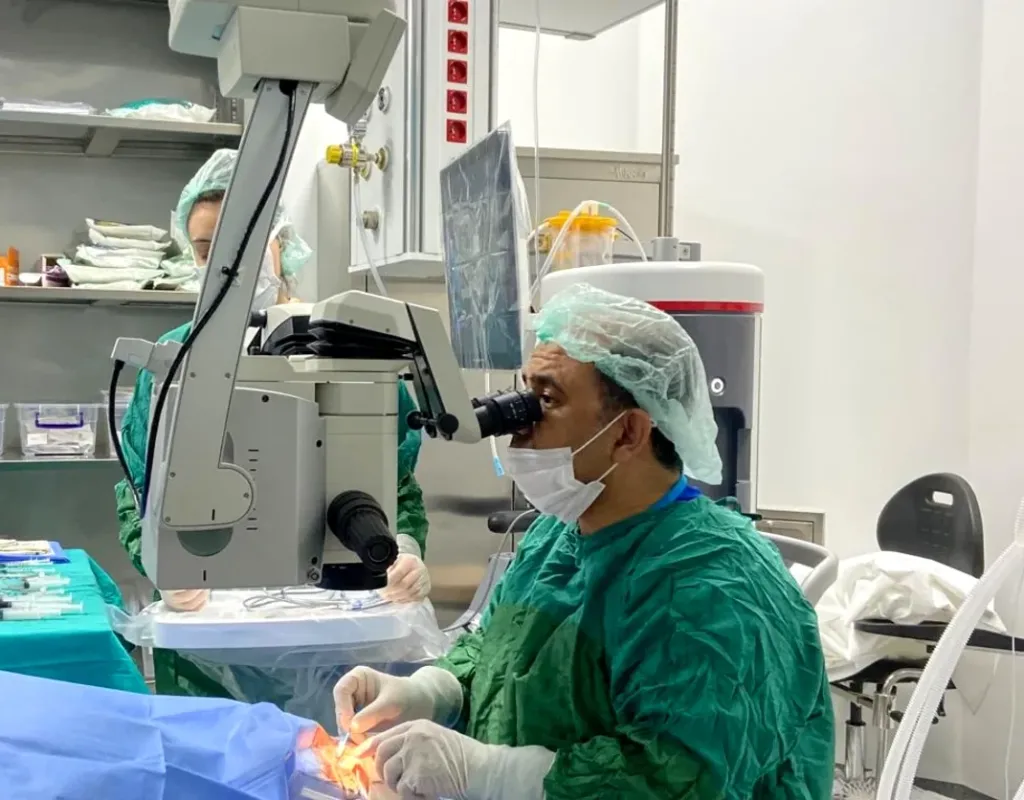
An EDOF lens is implanted with the same technique as cataract surgery: with anesthetic drops, through an incision of about 2–3 mm, using the phacoemulsification method (breaking up the lens with ultrasound), in 15–30 minutes, and you go home the same day.
- Drops that dilate the pupil and numb the eye are applied; the area around the eye is cleaned.
- A small incision is made at the edge of the cornea; a round opening is created in the front surface of the membrane that surrounds the lens.
- The natural lens is broken up with ultrasound and removed by suction; the back membrane is left in place.
- The foldable EDOF lens is delivered with an injector, unfolds in the capsular bag and is centered; a toric EDOF lens is rotated to the calculated axis.
- The incision is checked for leaks; a protective shield is placed over the eye.
During the procedure you feel light, mild pressure and touch; afterwards there may be stinging and watering for a few hours. Because you cannot drive after the surgery, you need to come with a companion.
EDOF lens surgery step by step
Removal of the natural lens and placement of an EDOF lens; how the range of focus is extended.
- Removing the natural lensThe natural lens is broken up with ultrasound energy and removed through a small incision; the capsular bag is preserved for the new lens.
- Placing the EDOF lensThe EDOF lens is inserted in folded form, unfolds inside the capsular bag and stays centred.
- Extended range of focusThe focus is not gathered at a single point but spread over a range. The transition between far and intermediate distances is continuous; glasses may be needed for very close work.
What is recovery like?
Distance and intermediate vision clear from day 1 in most patients; with an EDOF lens, the brain’s adaptation (neuroadaptation) is usually shorter than with a trifocal lens.
- Day 1: The protective shield is removed; eye pressure and the position of the lens are checked. Antibiotic and anti-inflammatory drops are started; mild haziness and stinging are normal.
- Week 1: Do not rub the eye, keep water out of it and do not lift heavy objects. Screen use and reading are allowed.
- Month 1: The drops are tapered and stopped; you wait a month before swimming pools, the sea and the hammam (Turkish bath). Any remaining prescription is measured; if reading glasses are needed for small print, they are determined.
If you are coming from Elbistan, Afşin, Göksun, Ekinözü or Nurhak, the day of surgery and the day 1 check-up are planned together; the later check-ups are arranged according to your travel conditions.
What are the risks and limitations of an EDOF lens?
The risks of EDOF lens surgery are the same as those of cataract surgery; the limitation specific to the lens is that near vision is more restricted than with a trifocal lens.
- Need for glasses for near reading: Light reading glasses may be needed for small print and reading in dim light; this is not a side effect but a design limit of the lens.
- Halos and glare: Although fewer than with a trifocal lens, halos may be seen around lights at night in the first weeks.
- Contrast: May be very slightly lower than with a monofocal lens.
- Residual prescription: Despite the measurements, a small prescription may remain; it is fine-tuned with glasses or, if the cornea is suitable, with laser.
- Posterior capsule opacification: The membrane the lens sits in can become cloudy over time; it is cleared with a YAG laser.
- General surgical risks: Infection, macular edema, a rise in eye pressure and retinal detachment are rare but possible.
EDOF or trifocal? A comparison
The basic difference between EDOF and trifocal is the balance between near vision and image quality at night: a trifocal lens gives clearer near vision, while an EDOF lens offers fewer halos and higher contrast.
| Feature | EDOF | Trifocal (multifocal) | Monofocal |
|---|---|---|---|
| Distance vision | Clear | Clear | Clear |
| Intermediate (computer, dashboard) | Clear | Clear | Limited |
| Near (small print, 40 cm) | Sufficient for large print; glasses may be needed for small print | Clear | With glasses |
| Night halos and glare | Low–moderate | Moderate; decreases over time | Low |
| Contrast (dim light) | Close to monofocal | Slightly lower | High |
| Adaptation period | Short | Weeks to months | Very short |
| Who it is for | Night driving, intermediate-distance priority | Wish to be largely free of glasses | Additional eye disease, the simplest image |
| SGK | Lens surcharge paid by the patient | Lens surcharge paid by the patient | Standard lens is covered |
A general comparison of all lens types is on the lens surgery page.
Assessment and planning in Kahramanmaraş
Your suitability for an EDOF lens is assessed with the examination and measurements at HG Hospital in Kahramanmaraş, Türkiye; the method that suits you is planned together. The examination is done by Dr. Nejmi Öztürk, an ophthalmologist working in cataract and refractive surgery; if you have a cataract, cataract surgery is performed by Dr. Öztürk at HG Hospital.
HG Hospital is a private hospital contracted with the Turkish social security institution (SGK); patients with valid SGK coverage may use it, although a private-hospital co-payment may apply. For these patients, cataract surgery with a standard monofocal lens is covered; if an EDOF lens is chosen, the lens surcharge is paid by the patient, and lens exchange done solely to be free of glasses without a cataract is generally not covered by SGK. Patients without SGK coverage, such as international patients and visitors from abroad, pay privately or through their private or travel health insurance; the hospital checks coverage before treatment, and fee information is given by the hospital after the examination.
Dr. Öztürk does not see patients in Elbistan; patients from Elbistan, Afşin, Göksun, Ekinözü and Nurhak come to HG Hospital in Kahramanmaraş. The examination and measurements are completed on the same day; travel and planning information is on the patients from Elbistan and the surrounding area page.
Dr. Nejmi Öztürk sees patients at HG Hospital in Kahramanmaraş, Türkiye. For patients travelling from other districts or from abroad, examination, tests and treatment planning can be arranged for the same day.
Hospital switchboard (within Türkiye): 444 46 46 · E-mail: info@nejmiozturk.com · HG Hospital, Üngüt Mevkii, Prof. Dr. Necmettin Erbakan Blv. No:209, Onikişubat / Kahramanmaraş, Türkiye
Frequently asked questions
Does an EDOF lens completely remove the need for reading glasses?
In most patients, a phone screen, price tags and medium-sized print can be read without glasses. Light reading glasses may be needed for small print, medicine leaflets and prolonged reading in dim light. If glasses-free near reading is your priority, a trifocal lens may be more suitable.
Why is an EDOF lens recommended for people who drive at night?
Because an EDOF lens does not split light into many focal points, halos and glare around lights at night are fewer than with a trifocal lens. Contrast sensitivity is close to that of a monofocal lens, which makes it easier to make out the road and signs in the dark. Mild halos may still be seen in the first weeks.
EDOF or trifocal — which should I choose?
If glasses-free near reading is your priority, a trifocal lens comes to the fore; if night driving and image quality are your priority, an EDOF lens does. For both, the macula and cornea must be healthy. The decision is made by assessing the measurements together with your daily habits.
How many minutes does EDOF lens surgery take?
Because it is done with the cataract technique, it usually takes 15–30 minutes. With preparation and rest you spend a few hours at the hospital and go home the same day. The two eyes are usually operated on separate days.
Is an EDOF lens covered by SGK, and how much does it cost?
For patients with valid SGK coverage, cataract surgery is covered; if an EDOF lens is chosen, the lens surcharge is paid by the patient. Refractive lens exchange without a cataract is generally not covered. Patients without SGK coverage pay privately or through their private or travel health insurance. Fee information is given by the hospital after the examination; insurance coverage is clarified at the consultation.
Does an EDOF lens correct astigmatism?
Yes; EDOF lenses have toric (astigmatism-correcting) options. The amount and axis of the astigmatism are measured with topography, and the lens is placed on this axis. In irregular astigmatism such as keratoconus, an EDOF lens is not recommended.
Can an EDOF lens be implanted in one eye and a trifocal lens in the other?
Yes; this is called a mix-and-match approach. The aim is distance and intermediate quality with an EDOF lens in the dominant eye and support for near reading with a trifocal lens in the other. Suitability, and which lens goes in which eye, are determined at the examination.
Where should I go for an EDOF lens in Kahramanmaraş?
The suitability assessment is done by Dr. Nejmi Öztürk at HG Hospital in Onikişubat, Kahramanmaraş. The examination and measurements are completed on the same day; for patients from Elbistan and the surrounding districts, the check-ups are planned together. You can use the contact section on this page to make an appointment.
Sources
- Turkish Ophthalmological Society — todnet.org
- American Academy of Ophthalmology (AAO) — aao.org
- European Society of Cataract and Refractive Surgeons (ESCRS) — escrs.org
- National Eye Institute (NEI) — nei.nih.gov
Related pages
- Trifocal lens (multifocal intraocular lens)
- Cataract surgery (monofocal and toric lens)
- Lens surgery — all options
- ICL (phakic intraocular lens) surgery
This page is for information only; diagnosis and treatment decisions are made after an examination. The results of any surgical or interventional procedure may vary from person to person. You are advised to obtain detailed advice from your physician before any procedure.

Ophthalmologist and eye surgeon. Graduate of Erciyes University Faculty of Medicine; completed his residency at Ankara Atatürk Training and Research Hospital. With 21 years of experience in cataract and refractive surgery, strabismus, glaucoma, retina and oculoplastic surgery, he sees patients at HG Hospital in Kahramanmaraş, Türkiye. Biography and training
Dr. Nejmi Öztürk
Ophthalmologist and eye surgeon
HG Hospital, Üngüt Mevkii, Prof. Dr. Necmettin Erbakan Blv. No:209, Onikişubat / Kahramanmaraş
+90 506 377 47 68WhatsAppAppointment formHospital switchboard (within Türkiye): 444 46 46 · info@nejmiozturk.com
- Private patients and private health insurance are welcome; patients with SGK coverage may use it (conditions are confirmed by the hospital)
- Same-day examination and test planning for patients travelling from other districts or from abroad
- Getting here and patient information
- Patients from Elbistan and the region