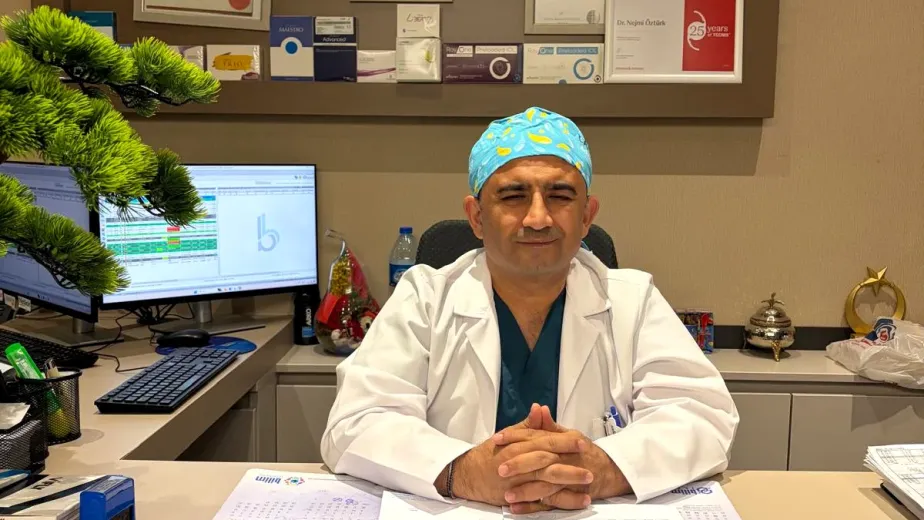

At Private HG Hospital in Kahramanmaraş, Türkiye, by Dr. Nejmi Öztürk, ophthalmologist — an awareness and early-diagnosis guide for families
- What amblyopia is — why vision stays low even though the eye itself is healthy
- Causes — a difference in prescription between the eyes, high refractive error, strabismus, conditions that obstruct vision
- Early diagnosis — the age-dependent window of visual development
- What families can and cannot notice
- What happens at the examination and why measurement with drops is needed
- An overview of treatment approaches and the importance of follow-up
Lazy eye is one of the common causes of reduced vision in childhood, and it often causes no complaints at all. This article focuses on when a family should act; the treatment steps are described in detail on the strabismus (squint) and lazy eye page.
What is lazy eye (amblyopia)?
Lazy eye (amblyopia) is reduced vision in an eye even though the eye is structurally healthy. Vision is not an event that happens in the eye alone: the eye receives the image, the optic nerve carries it to the brain, and the visual centers of the brain interpret it. These centers do not arrive ready-made at birth; they mature in early childhood, through the clear images that come from both eyes.
If a blurred, incomplete or markedly different image goes from one eye to the brain, the brain begins to suppress the image from that eye in order to prevent confusion. The eye that sees clearly takes over, and the connection between the suppressed eye and the visual centers stays weak. As a result the eye looks healthy at examination and the back of the eye is normal, but the vision of that eye measures low even with glasses.
This developmental period of the visual pathways is also what treatment relies on: as long as development continues, it is possible for the brain to learn to use the weaker eye. After development is complete, gains may be limited, and the response varies from child to child.
Why does lazy eye occur?
Beneath amblyopia lies a condition that prevents one eye from producing a clear image or prevents the brain from using the two eyes together. Common causes are as follows:
- Difference in prescription between the two eyes (anisometropia): One eye may see clearly while the other has a markedly higher prescription; because the child looks comfortably with the better-seeing eye, they do not complain. Unless vision is measured, this difference cannot be told from the outside.
- High refractive error: If there is high hyperopia (farsightedness), myopia (nearsightedness) or astigmatism in both eyes, the image reaching the brain stays constantly blurred and the visual development of both eyes may lag together. The child does not describe this, because they have no experience of “clear vision” to compare it with.
- Strabismus (eye turning): When the eyes cannot look at the same point, two different images reach the brain. To avoid double vision, the brain suppresses the image from the turned eye, and lazy eye may develop in the suppressed eye.
- Conditions that physically obstruct the visual pathway: In congenital cataract, droopy eyelid or clouding of the cornea, the image is prevented from reaching the retina. In this group lazy eye starts early and develops quickly; the underlying problem needs to be assessed in good time.
If there is a family history of lazy eye, strabismus, a high glasses prescription, congenital cataract or childhood glaucoma, the child’s check-ups should be done without waiting and more often. Babies born early are also more likely to have refractive errors, strabismus and lazy eye.
Why does it need to be noticed early?
Visual development has an age-dependent window. While this window is open, the visual centers of the brain are still taking shape, and it is possible for them to adapt to the image coming from the weaker eye. As age advances, this flexibility decreases. In amblyopia, what is decisive is therefore not just which treatment is applied but the age at which treatment is started.
In cases that are noticed late, the reduction in vision may be permanent. In daily life the consequence is more than “one eye seeing less”:
- Depth perception (stereopsis), which depends on the two eyes working together, may stay weak; difficulty may be seen in tasks such as catching a ball and judging distance.
- School activities such as reading, writing and following the board may become harder, regardless of the child’s ability.
- If a disease or injury affects the healthy eye, daily life is affected more, because the vision of the remaining eye is low.
- Vision standards for a driver’s license and some occupations look at the vision level of each eye separately.
For this reason the approach in children’s eye health is not to wait for complaints to appear, but to follow visual development with planned check-ups from the newborn period to preschool. The recommended check-up steps for each age are described in detail in the article on eye health in children and babies.
What do families notice, and what can they not notice?
The point on which families are most often mistaken is the idea that lazy eye has a visible sign. Yet lazy eye developing in one eye often gives no sign at all: the child sees clearly with the other eye and so does not struggle, squint or complain. The observation that “he plays comfortably and watches television without any problem” therefore does not show that lazy eye is absent.
Signs a family can notice at home
- One of the eyes turning in, out, up or down; the turning becoming more obvious with tiredness or in photographs
- Constantly tilting the head to one side or raising the chin to look
- Becoming markedly upset when one eye is covered but not reacting in the same way when the other is covered
- Getting too close to the screen or a book, squinting when looking into the distance
- The eyelid partly covering the pupil; especially if there is a difference between the two eyes
- Whiteness or cloudiness in the pupil, the red reflection of one eye missing in photographs
- Difficulty reading, skipping lines and headache
Situations in which a family cannot be expected to notice
- A difference in prescription between the two eyes: The eyes look completely normal from the outside and there is no turning; the difference appears only when the eyes are measured separately.
- Lazy eye developing silently in one eye: The child uses the eye that sees well and does not describe the problem.
- Small-angle, inconspicuous turning: Small deviations in the alignment of the eyes cannot be seen with the naked eye; a cover test is needed.
- “Eye test” attempts at home: A child counting fingers or seeing a toy does not mean that the level of vision has been measured; with both eyes open the child easily compensates.
In short, the family’s observation is valuable but not sufficient; cases in which lazy eye runs silently are caught only by a screening examination appropriate to the child’s age, done without waiting for complaints.
The short video below shares a recording made during an examination.
How is lazy eye diagnosed?
The diagnosis is made by showing a difference between the vision levels of the two eyes and finding the cause that explains this difference. The steps of the examination change with the child’s age:
- Measuring visual acuity: Each eye is assessed separately. In babies who cannot speak, behavioral measures such as following light and faces and the reaction to covering one eye are used; in preschool children picture and shape cards, and in older children letter charts.
- Refraction with drops (cycloplegic refraction): Because a child’s focusing muscle is very strong, the eye focuses by itself during measurement and does not show its true prescription; measured without drops, the prescription can come out lower than it really is. Drops that temporarily relax the focusing are instilled, and the measurement is taken after about 30–45 minutes; the blurring of near vision and the sensitivity to light are temporary.
- Eye movements and alignment assessment: Cover tests show whether there is turning, its direction and whether it is constant or intermittent; the amount is measured with prisms. The movement of the eyes in the nine directions of gaze is examined.
- Anterior segment (front of the eye) examination: The eyelids, cornea, pupil and lens are examined under a biomicroscope (slit lamp); the examiner checks whether there is a condition obstructing the visual pathway.
- Fundus (back of the eye) examination: With the pupil dilated, the retina, the optic nerve and the blood vessels are assessed; it is distinguished whether a cause involving the retina or the optic nerve lies behind the reduced vision.
- Binocular vision tests: Depth perception and how well the two eyes work together are measured.
Preparation for the family is simple: the child should not be hungry or very tired, any previous glasses prescription and reports should be brought, and half a day should be set aside for the examination with drops. Diagnosis and treatment decisions are made after an examination.
An overview of treatment approaches
The order followed in the treatment of lazy eye is to ensure that a clear image reaches the brain, and then to make the weaker eye work. In general the steps are as follows:
- Sharpening with glasses: The prescription found in the measurement with drops is corrected with glasses; in some children vision rises within months with regular use of the glasses alone. The belief that glasses make the eye lazy is not correct.
- Patching (occlusion) therapy: The healthy eye is covered for set periods so that the weaker eye is used. The duration is set by the doctor according to the child’s age and the degree of the difference in vision, and it is changed at check-ups.
- Blurring with drops (penalization): In some cases where patching cannot be tolerated, an option of drops that temporarily blur the near vision of the healthy eye is considered.
- Treatment of the underlying cause: In conditions such as congenital cataract, droopy eyelid or constant turning that does not correct with glasses, surgery may be needed. Surgery addresses the obstruction in the visual pathway or the alignment of the eyes; lazy eye itself is still managed with glasses and patching.
What these treatments have in common is that they need time and consistency. The process takes months, check-ups are carried out at set intervals, and treatment is continued with gradual reduction until the gained vision is maintained. If treatment is stopped early, vision may slip back; adherence is therefore as decisive as the method chosen. Making a plan that fits school and play routines, and presenting patching to the child as an ordinary part of the day rather than as a punishment, makes adherence easier. Results may vary from child to child.
Details such as how patching durations are set, prism and botulinum toxin applications, the steps of strabismus surgery and the recovery process are described on the strabismus (squint) and lazy eye page.
Children’s eye examination in Kahramanmaraş
Measurement of vision level, refraction with drops, cover test and fundus examination in children are carried out at Private HG Hospital in Kahramanmaraş, Türkiye, by Dr. Öztürk, ophthalmologist. Because an examination with drops involves waiting, choosing an appointment time that suits the child’s routine makes the process easier.
For families coming from Elbistan, Afşin, Göksun, Ekinözü and Nurhak, the examination and tests are planned for the same day as far as possible; it helps to mention this when booking. Appointment and travel information is on the contact page.
Frequently asked questions
Does lazy eye go away by itself once the child wears glasses?
In some children, correcting the prescription with glasses raises vision within months, which is why treatment usually starts with glasses. Glasses are not enough in every case, however; if the difference in vision persists, treatment aimed at making the weaker eye work is added. Whether the glasses are enough is seen from the vision measurements at check-ups.
My child never complains; could there still be lazy eye?
There could. Lazy eye developing in one eye often gives no sign; the child sees clearly with the other eye, so does not struggle and does not describe the problem. This is why a screening examination appropriate to the child’s age is recommended without waiting for complaints.
Can I tell at home by myself?
A family can notice signs such as eye turning, tilting the head to look, a droopy eyelid or whiteness in the pupil; if these are seen, do not wait for the scheduled check-up. A difference in prescription between the two eyes and small-angle turning, however, cannot be detected at home. A child counting fingers or seeing a toy does not mean that the level of vision has been measured.
Up to what age can lazy eye be treated?
The response to treatment is better in the years when visual development is continuing, which is why starting early matters. Treatment can also be tried after development is complete, but the gain may be limited. Age and the expected response are assessed according to the examination findings.
Why is an examination with drops needed?
Because a child’s focusing muscle is very strong, the eye focuses by itself during measurement and does not show its true prescription; measured without drops, the prescription can come out lower than it really is. Drops that temporarily relax the focusing remove this error. The blurring of near vision and the sensitivity to light after the drops are temporary.
Can patching harm my child’s healthy eye?
When patching is applied within the duration and check-up schedule set by the doctor, it is not expected to permanently affect the vision of the healthy eye. This is why check-ups are done: at each examination the vision level of the two eyes is measured separately and the duration is adjusted accordingly.
How long does treatment take?
The process takes months; a common timetable cannot be given. Check-ups are carried out at set intervals, and treatment is continued with gradual reduction until the gained vision is maintained. The duration varies with the degree of the lazy eye, the child’s age and adherence to treatment.
What happens if we stop treatment midway?
If treatment is stopped early, the vision gained may slip back. For this reason, even after vision has risen, treatment continues at a reduced level and check-ups go on. If adherence is difficult, sharing this at the examination, instead of stopping treatment, allows the plan to be rearranged to suit the child.
Where are children’s eye examinations done in Kahramanmaraş?
Dr. Nejmi Öztürk carries out eye examinations for babies and children at Private HG Hospital in Kahramanmaraş. Families coming from Elbistan, Afşin, Göksun, Ekinözü and Nurhak should set aside half a day for the examination with drops; appointment details are on the contact page.
Sources
- Turkish Ophthalmological Society — todnet.org
- American Academy of Ophthalmology (AAO) — aao.org
- National Eye Institute (NEI) — nei.nih.gov
Related pages
- Strabismus (squint) and lazy eye
- Eye doctor in Kahramanmaraş
- About Dr. Nejmi Öztürk
- Contact and appointments
This article is for informational purposes; diagnosis and treatment decisions are made after an examination. The results of any treatment or interventional procedure may vary from person to person. You are advised to obtain your doctor’s opinion on decisions about your child’s eye health.

Ophthalmologist and eye surgeon. Graduate of Erciyes University Faculty of Medicine; completed his residency at Ankara Atatürk Training and Research Hospital. With 21 years of experience in cataract and refractive surgery, strabismus, glaucoma, retina and oculoplastic surgery, he sees patients at HG Hospital in Kahramanmaraş, Türkiye. Biography and training